

Friday 23rd May, 2025
As the sun glistens over the still water in the Royal Victoria Dock in London´s East End, I stand, grasping hold of the cold iron railings that separate the dock from the walkway. The towering Stothert & Pitt cranes cast long, elegant reflections in the water below—silent sentinels of a bygone era. I close my eyes for a moment, trying to picture the bustling energy of this place when it first opened in 1855, a lifeline for steamships connecting trade and industry to the nation's growing railway network.
Today, I know emotions will run deep. After a short visit to Customs House to apply for a new passport, I prepare to walk the streets of the East End, paths that whisper stories of childhood struggle and resilience.
My work with street-living children in Central America has stirred something within me, raising questions that echo in my heart: Why do systems often trap people in cycles of poverty? And how can we create spaces where freedom is more than just a dream, but a doorway to transformation?
As I embark on what may become a five- or six-year journey into the history of street-living children, I find myself deeply moved by the haunting stories of those who once wandered the streets of London in the 1800s. The voices of social historians paint a vivid and sobering portrait of young lives shaped by hardship, neglect, and abuse. Thousands of children were trying to survive in the shadows of the city’s rapid expansion.
What strikes me most is the unsettling familiarity of their plight. The faces and names may change, the accents differ, but the struggles of those children mirror the same pain and poverty I have witnessed among street-living children in Mexico City, Guatemala City, Tegucigalpa, Honduras, and Bogotá, Colombia. Across time and continents, their stories echo each other with tales of survival, vulnerability, and the desperate hope that merely existing one more day might lead to a brighter future.
The cobbled streets of Victorian London and the cracked pavements of modern Guatemala City appear, at first glance, worlds apart, separated by oceans and centuries. Yet, as I delve deeper into the lives of the thousands of children who once called the soot-streaked alleys of 19th-century London home, I begin to see reflections, faint but unmistakable, in the eyes of the children I have worked with in Central America.
Then, as now, poverty was not merely an economic condition but a cage, confining generations within a cycle of invisibility and survival. In London, young children sold matches or shoelaces to passersby, slept beneath bridges or in doorways, and evaded the brutal grasp of the workhouse.
Today, their counterparts in Tegucigalpa or Guatemala City shine shoes at busy intersections, beg at bus terminals, or rummage through piles of rotting rubbish for scraps, haunted by the same hunger, fear, and fragile hope. Both then and now, systems intended to protect often failed them; families fractured under pressure, and society turned a blind eye until their stories became too loud to ignore.
Eager to grasp the spirit of London’s East End, I wander its winding streets, aware that so much of what once stood here has been swept away by waves of redevelopment. Yet, now and then, a lone red or yellow brick building rises like a relic from another time. These enduring structures, with their weathered facades and dignified symmetry, speak to the brilliance of neo-classical architects who once blended stone and vision with such grace. They are more than architectural curiosities; they are monuments to a turbulent chapter in Britain’s history, a time when the industrial revolution shattered the rhythm of rural life and lured thousands into the smoky heart of the city.
The stories of London’s street-living children are as numerous as they are heartbreaking. Thanks to the work of social historians and commentators, we are left with a vivid and often harrowing portrait of life in the East End during the height of urban poverty. These accounts reveal a world where childhood was fleeting and often cruel.
I was horrified to discover that the life expectancy for a child in this part of the city was a mere sixteen years. Hunger gnawed at their stomachs, bitter winters claimed their fragile bodies, and unsafe, exploitative labour stole what little innocence they had left. Among the most tragic were the young boys, some as young as five, who were forced into the narrow chimneys of the city’s fine homes, recruited as sweeps and destined for suffering. Rarely did they live past ten. For them, there were no warm beds, no safe havens, only soot, silence, and the shadow of early death.
My wandering steps lead me through the bustling present-day streets of London and into the heart of Tower Hamlets, where I find myself on Copperfield Road - a name bestowed in 1868 in honour of Charles Dickens’ beloved character, David Copperfield, whose story echoes the struggles of so many children of his time.
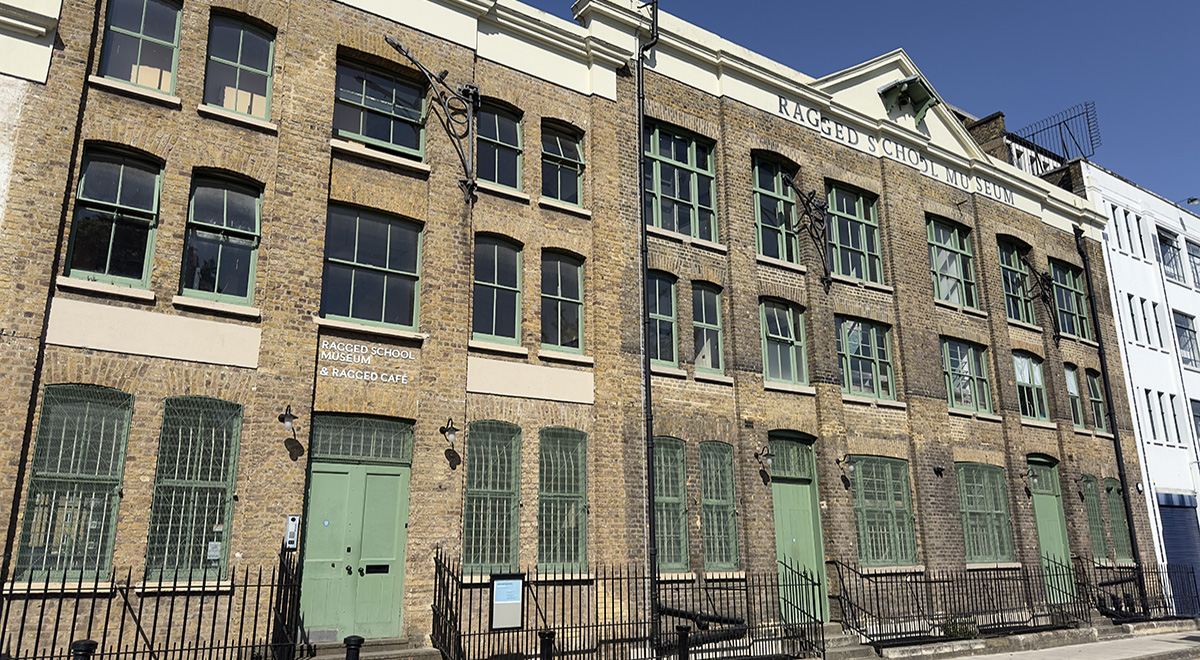
Here, nestled beside the quiet waters of the Regent’s Canal, stands the Ragged School Museum, a solemn yet inspiring tribute to what once was a lifeline for the city’s most vulnerable. Within these brick walls, generations of homeless, orphaned, and destitute children - those once described as “raggedly clothed” - were given not just an education, but dignity, warmth, a hot meal, and a glimpse of hope.
As I wandered into the building, it still breathed with the echoes of chalk on slate, the whispered prayers of hungry children, and the tireless efforts of those who believed every child, no matter how poor, deserved a future. The school desks were still in place, and the worn, creaky floorboards were testimony to thousands of children who had walked, run or skipped through this impressive building.
The Ragged School on Copperfield Road was the vision of the Christian philanthropist, Dr. Thomas Barnardo, a tireless advocate for the countless children surviving on London’s unforgiving streets. Transforming a disused warehouse into a beacon of hope, Barnardo opened the school in 1877, dividing it into two sections, one for boys and one for girls. The school provided free lessons and meals for thousands of impoverished children for over three decades until its closure in 1908. Barnardo’s mission was more than charity; it was compassion-based justice.
In 1867, Dr Barnardo invited the Earl of Shaftesbury, already a reformer in his own right, to encounter the stark realities of child homelessness in London. What Shaftesbury saw deeply unsettled him: wide-eyed, shoeless and ragged children sleeping under canvas sheets, scavenging for survival. Moved by his Christian convictions and stirred by Barnardo’s urgent call, Shaftesbury joined the effort. Together, their faith ignited action, and their partnership laid the foundation for a movement that would forever change the fate of street-living children in Britain.
As I step out of the Ragged School Museum, the past still clinging gently to my thoughts, a lively school group rushes in behind me, their laughter echoing through the old hallway that once held rows of young children, sitting at desks and desperate to learn. The space, now a modest gift shop and exhibition room, bears witness to the thousands of children who once found refuge and hope within its walls.
I linger outside, letting the group of children pass, and wait for the street to fall quiet so I can capture a photograph, a keepsake of what I feel is a sacred place. Just then, a young mother walks by with her young daughter, hand in hand, likely unaware of the building’s profound legacy. They walk along the sun-baked pavement where once 600 hungry, barefoot, ragged children gathered daily for lessons, food, and warmth.
Two days later, with the echoes of history still stirring in my heart, I am welcomed into the warm hospitality of Dr. David and Mrs. Ann Barnardo, descendants of Dr. Thomas Barnardo himself. Over lunch in their beautiful home in Surrey, we share memories, speak of Dr. Thomas Barnardo´s enduring legacy and the astonishing parallels between his mission in the slums of Victorian London and the work I’ve embraced with street children in Central America.
In that moment, the past and present gently fold into one another. Two very different stories, centuries apart, yet bound by the same heartbeat of compassion.
As I drive back to Amersham, the countryside unfolding around me, I carry with me more than just the weight of history. I carry a sense of calling. What lies ahead is more than a study; it is the beginning of a journey—one that will stretch across continents and centuries.
Along the way, I will share with you the stories I uncover, the echoes of resilience, sorrow, and hope that still linger in the lives of street-living children across the world. Together, we will explore not only what was, but what still can be. We will explore how compassion, faith, and action can continue to change the story for those who have long been cast aside by family, friends and society.
 Duncan Dyason is the founder and Director of Street Kids Direct and founder of Toybox Charity. He first started working with street children in 1992 when he moved to Guatemala City and founded The Toybox Charity. His work has been honoured by Her Majesty the Queen and he was awarded an MBE the year he celebrated working over 25 years to reduce the large population of children on the streets from 5,000 to zero. Duncan continues to live and work in Guatemala City.