- +502 5522-3333
-
This email address is being protected from spambots. You need JavaScript enabled to view it.


-

Monday 10th April 2023
According to UNICEF nearly half of all children under five years of age in Guatemala suffer from chronic malnutrition. Most of these children will live in distant rural communities where help, advice and support are not as available as it is here in the city.
However, most of the children we work with and who have lived on the streets over the years have come from indigenous communities from these rural settings. The impact of malnutrition in the early years leads to stunted growth and many of the young children we work with here in Guatemala City are very undeveloped for their age. Our evaluations of them sadly demonstrate their place on the developmental scale and it´s not great.
A few weeks ago I took little Jonathan to the doctor as he was suffering from parasites again and the doctor wanted to do some more tests to see why he was so small for his age. He is not eating much and struggles to make any progress with his height and is clearly not happy and this is leading him to become rather down and can lead to being bullied and other issues around his self-esteem.
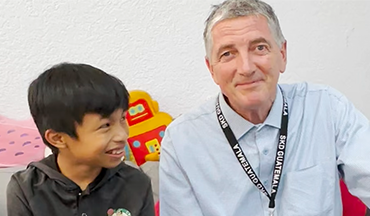
Today though I am with Antoni, a new boy who has started to come to the mentoring centre. He does not know me well as he has only seen me once on my return from the UK recently. It is clear that he is excited about being in the mentoring centre and is focussing hard on a worksheet that is helping him learn to form letters.
During the pandemic he was studying from home. However, he had no access to the educational materials as he has no internet and so his mum was trying to find ways to keep him in school even though they were closed. The Guatemalan government decided to pass all children on the books despite many not learning anything at all.
Antoni is now 13 and can´t yet read or write. His mum and older sisters run a small food stall on the street in La Terminal and he has grown up there and sees the streets as his home. Due to his high connection to the streets and seeing he was at risk, the street team decided to invite him to the mentoring centre. He now comes every day and is clearly flourishing with his education as he sits with me and helps me with a word search on my phone.
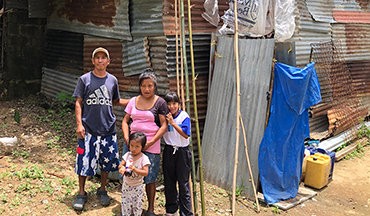
Today I walk him back from the centre to where his family are getting ready to prepare some snacks for the evening commuters before they walk home to the room they rent in La Terminal, all seven of them.
It is great to spend time getting to know Antoni´s mum and sisters and their story is heart-warming and is another long story of how her family moved from the countryside during the civil war to the city. The mum is clearly working hard to support her children and the long hours takes their toll on her, but she smiles and tells me she loves caring for them but has been concerned that Antoni is in the streets all the time. Having him now attend the mentoring centre has changed his life and put him in contact with other children and with caring adults who have helped him see that he can achieve his God-given potential.
Despite being 13 you would think Antoni is 10. His body is very small and frail and he tells everyone his date of birth in order to give credibility to his story of why he is so small. It is doubtful he will grow much more but with the support we can offer he could gain some weight and might increase in height when puberty hits.
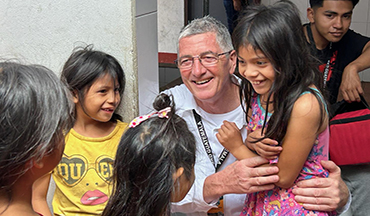
Thankfully we have had a visit from the British Ambassador, Nick Whittingham, who was accompanied by David Rutley MP. The visit coincided with a large donation of vitamins for children, arranged by the embassy from Drogueria Italiana here in the city.
The vitamins will be given to the children and their families and the supply will be enough for the next six months. There is also plenty to share with various other projects in the city that work with children at risk.
Handing out vitamins to the children each day is only one solution to helping them recover from years of malnutrition. It is part of the package we can offer to keep children focussed on their education and not take those early steps to street life.
Antoni enjoys his daily vitamins and we are hopeful that he will continue to commit to learning with us this year and then next year start school full-time.
I know I say this a lot, but your support really does help us reach these kids and make a difference in their lives. Thank you and please do pray for Antoni and I am sure that over the year we will see him thrive and grow.
 Duncan Dyason is the founder and Director of Street Kids Direct. He first started working with street children in 1992 when he moved to Guatemala City and founded The Toybox Charity. His work has been honoured by Her Majesty the Queen and he was awarded an MBE the year he celebrated working over 25 years to reduce the large population of children on the streets from 5,000 to zero. Duncan continues to live and work in Guatemala City.
 -
Tuesday 16th May 2023
It´s a 12-hour drive from Guatemala City to Tegucigalpa, the capital of Honduras and last week´s drive down was a great time to think, reflect and pray. This time I had Sony, Danilo and Sergio with me as Danilo and Sergio had been invited to spend two weeks in Talanga, Honduras, where the Proyecto Alas mentoring centre is. Their time in Talanga I know will be filled with unforgettable times of working with the Alas team and the children and sharing something of their lives and stories with the 60 at-risk kids in the programme.
While I was there I needed to spend time thinking about the mentoring session I had with the older boys on my return. Our theme was ´How we see the World´ and the basic idea is that we all see the world and other people through our eyes of culture, race, religion, experience, age and gender. I wanted the boys to begin to explore how we could consider seeing the world through “other eyes” and also to see people as God sees them. Stick with me!
Our text was from John´s Gospel and recounted the time Jesus met a woman at a well. From all perspectives she was a Samaritan, a woman and someone who was drawing water from a well at the hottest part of the day. So many questions came from this encounter. But Jesus was able to see something far more profound in her and that led us to talk about how we could also look around us and try to see people as God sees them. What is it we can see when we begin to look more profoundly at a person´s life. What can we learn? It was a very interesting session indeed and we finished by watching the same scene on The Chosen and if you haven´t see this I would recommend it highly.
The thought came to my mind this past week while in Honduras as I sat and watched the kids that come into the mentoring programme in the Alas centre in Honduras. One group was watching a cartoon on TV and enjoying it thoroughly, the rest were sitting at a large table and colouring and doing homework, all being helped by staff and volunteers. But, one little boy sat alone.
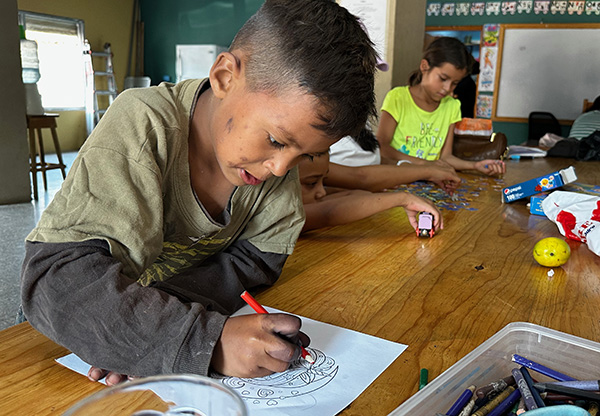 I sat next to him and watched him colouring a sheet of paper. It was interesting observing him work and I studied his concentration and couldn´t help but notice the black dye on his hands and face. The dye was also on his clothes and he had obviously been using dye for his or another person´s clothes or for colouring wood. Maybe he was a worker. It was interesting just watching him for a while and asking the question of what more could I see about his life. Why was he sitting alone? Why was he so dirty, not just his clothes but days of ingrained dirt in his skin. I guessed his age at around 6/7 and this was later confirmed to be 6. I wondered what he would tell me about his colouring and maybe more information about his life and family.
Children have this amazing way of telling you so much without even speaking and I was keen to listen and learn. His concentration was intense and he would not be enticed to play a game that two children were playing near him and was not drawn to the loud noises that came now and again when new children came into the centre. Not once did he smile or look at me.
After a short while I decided to engage and asked if he would like some help. He nodded and I picked up some of the colouring pencils and started to sharpen them for him. I was then invited into his world and now I was allowed to join him in colouring the sheet, with a special attention to stay within the lines, something he was also very careful to do.
I then learned his name; Jefferson and he was 6 years-of-age. He remained focussed on the sheet and would not look up or look at me. He seemed content and felt safe and I wondered if he had come alone to the centre, how long he had been coming and why he was there.
It was sometime later that I was told a little of his story. When he was much younger his mum left the family home and took him with her to live with another man. He now had a new dad and like any young child this transition is a very hard one to make. Also he was now living in the mountains and so was isolated and powerless to contact his father. As time went by it seems his mother lost interest in him and he found himself being shipped to his grandmother in town. Another move and another loss.
Jefferson had come to the mentoring centre with his two aunties, both of whom are young children and not able to look after him. So he spends his time in the streets begging and trying to get by – and he is 6!
I spent a very special hour with a very smart, resilient and focussed kid. He is packed with potential and I am sure with some love and care would eventually come to smile. For now the project is doing what they can to get him into the mentoring programme, but the spaces are few and the budget tight. I am hoping they will take him in and offer him what his demeanour and behaviour are shouting out loudly for – I want to be loved.
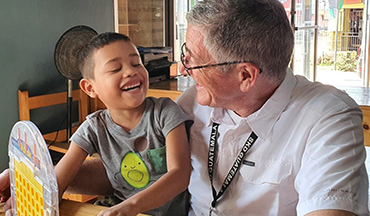
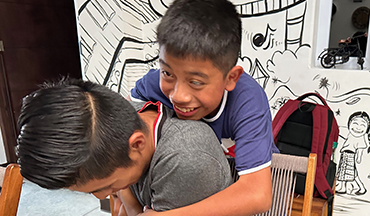
My time in the centre did end on a happier note when I was asked to play connect four by little Derek (photo at the top of the article) who is 5 and can´t stop smiling. Despite his infectious laugh, engaging personality and winning streak I could not stop thinking of Jefferson who was now nowhere to be seen.
The work we do in Honduras and Guatemala is vital and reaches kids that many overlook. Your support really does make a difference and can change the trajectory of a child´s life. Thank you for your interest, for reading the blogs and for your support. It´s good to know you are there.
Duncan Dyason is the founder and Director of Street Kids Direct. He first started working with street children in 1992 when he moved to Guatemala City and founded The Toybox Charity. His work has been honoured by Her Majesty the Queen and he was awarded an MBE the year he celebrated working over 25 years to reduce the large population of children on the streets from 5,000 to zero. Duncan continues to live and work in Guatemala City. -
Saturday 18th February 2023
Many of us have been in those moments when we receive news of a loved one who has passed away and we are left in shock and often can´t believe what we are hearing. We can quickly say something like: “but I only saw them yesterday”. Dealing with the death of someone we care for is not an easy time and one can often feel guilty, angry, sad as well as suffer a tremendous sense of loss.
Within 48 hours we had two such calls over the last two weeks and the first was from one of the guys who lives in the streets of Guatemala City, informing me that Erica is lying on the streets and not moving. We had been with her a few days before and she was her usual self – happy, smiling and trying to wind us up.
I have known Erica for over 20 years and have seen this young teenage girl grow up on the streets of the capital and in an area that is well-known for a whole list of activities that I would rather not go into right now. It is here Erica grew up, learned life´s hardest lessons and quickly was assumed into the culture of street life. Her survival mechanism led her to becoming a young mum and drug addict and then suffering from various sexual infections together with regular beatings, hunger, cold and her fair share of traffic accidents. The impact of all this led her to lose control of her limbs and was left completely unable to walk.
 Every visitor that walked along the fifth street in La Terminal eventually came across Erica and would always comment on her smile and her joy at being greeted and loved. She would often ask us for a drink of Coke and was very specific about what type of Coke she required and might even send back to the shops the visitor who bought her the wrong brand!
Sadly her body could just not cope anymore and gave up its fight and freed her from her day-to-day pain in this life. She spoke often about going to heaven and trusted that God would forgive her bad choices and offer her the eternal home she often dreamed would be there for her one day.
Like so many in the streets, death is close and when it comes we have a well-rehearsed plan in place that ends with a funeral and yet more moments of reflection for those still alive.
Erica was loved and tried to love much. We miss her and walking down the fifth will never be the same now as one can´t help but glance to “her spot” and remember the joy she always expressed when she saw your face.
No sooner had we returned from the cemetery the phone rang and my friend Oscar is crying on the other end. Oscar started with me in the mentoring programme when he was 10 years of age, but I have known him almost all his life. He is now crying on the phone and trying to tell me that his brother-in-law is lying on the floor dead and does not know what to do.
I head over to the tin shack where he lives and ask Juan Carlos, who works with us on the streets, to meet me there and help. On arrival I discover the 37-year-old lying on the concrete floor of the tin shack. It is hard to see as there are many people standing over his body, together with his wife Maria and her three children.
So many of the children we work with come from very fractious families. The reason why most kids take to street life is because of the state of their family. These three children are not the exception and sadly I know well the phases they will now go through over the coming hours, days and weeks.
 The youngest boy, Daniel, is 7 and continues to lift back the curtain that is being used as the door for their home. I watch him over the next two hours and every time he comes into his home he just stares at his dad´s hand, the only part of him you can see as he is covered up by a sheet. The next eldest is Jonathan (photo), who is 9, and he seems to understand a little more than his younger brother that his dad is not getting up this time. The eldest daughter, Vivian who is 13, is coping by looking though her dad´s phone for photos and posting them on his social media account. With each photo there is a pause as she remembers happier days.
The funeral is the following day and we arrange everything as the family are unable to think straight right now. What they can do is focus on one thing, the wake, as we arrange for the body to be collected, prepared and re-dressed and delivered back with all the things needed for the family to spend the night grieving together.
Later the following day and after the funeral I visit the family to see how they are doing and to offer our support. Thankfully some good friends in both the UK and Guatemala have sent in donations to cover the cost of the funeral, so that is one thing less for Maria to worry about. What I discover is that they are three months behind with their rent and have no food whatsoever in their shack. Thanks again to a generous donor in the UK we have been able to sort out the rent, buy some food and help them think about the coming weeks as their children start school again.
The family will need ongoing support and guidance and I can see more children now entering into the mentoring programme. Being there is sometimes all we can do, but it is often all we need to do. Thanks to your support we can be here and be the extended hand that expresses your love to vulnerable children and families. Once again, thank you for your support.
Duncan Dyason is the founder and Director of Street Kids Direct. He first started working with street children in 1992 when he moved to Guatemala City and founded The Toybox Charity. His work has been honoured by Her Majesty the Queen and he was awarded an MBE the year he celebrated working over 25 years to reduce the large population of children on the streets from 5,000 to zero. Duncan continues to live and work in Guatemala City. -
Friday 9th June 2023
Poverty debilitates, it crushes hopes, robs you of dignity, makes you vulnerable to exploitation and violence and leads to greater social exclusion with its negative health outcomes. Poverty is not just a mind-set, but a day-to-day reality for all the children we work with. Growing up in poverty will mean you can´t access good education, you will probably live in a home that has no running water, toilet or safe place to sleep. Your home is probably not yours and so are at constant risk of losing it. Children that grow up in poverty and from a single-parent family are far more likely to head to the streets or become members of a local gang.
I certainly know the reality of the world of children living in poverty as that is where I grew up. It was my personal experience as a child who survived by eating plants and fruit from other people´s gardens. I understand the way poverty limits your choices and entices you into thinking that life can never get any better.
Sunday was a great day! I met the four teenage boys I mentor in Santa Faz on the outskirts of Guatemala City and, together with Carlos who now helps me run the group, we began to explore how our thinking determines our behaviour and life choices. It was true, the boys confirmed, that your life will always move in the direction of your most powerful thoughts. The more one thinks about something, the more likely one is to put those thoughts into action.
It was a rather deep session to be honest, but I could see that the boys loved hearing about my own childhood stories of having the voice inside saying “do it” and the voice of reason that makes you consider the consequences of doing it. I am glad that my mistakes and failures can now be used to great effect and can help children understand how their thinking can determine their future.
We finished with the game Spite that the boys did not want to end and asked if we could play it next time we meet. They were happy, had been challenged and had enjoyed their first mentoring session in the new centre in the middle of town.
We are now renting, for just £100 a month, a small shop that is so perfectly situated across from the park and next to the school and police station that only God could have made this happen. The “CasaClub” centre will open more and more as we recruit and train volunteers and are hopeful that we could start a small business there in order to cover the costs of running this.
As always, Carlos and I walk the boys to their homes. All have homes that are made of tin and the floor is just dirt and not one has a flushing toilet or running water. But that is all they know and they are happy and just love the weekly sessions and can´t wait till we meet again.
On dropping home one of the boys we meet his little brother on route and I could see his was distressed. He is 10, tiny and is the most at-risk kid we have here due to his high-connection to the street and the local gang. He has never showed much emotion in the time I have known him and keeps a guard up that always seems so impenetrable. Today, however, was different. He was crying and when I stood next to him it was as if years of tears he had pushed down deep came to the surface.
I hugged him and allowed him to cry and tell me what was going on. He is one of the few that has a mum and a dad, even though the mum feels very much like a single parent. Just four hours before meeting him his dad had been arrested and taken to the courthouse and sentenced to an indeterminate time in prison. His world was destroyed and he had to face the fact that things were now going to be different.
We walked him home and his older brother was now in tears and both boys were struggling to know what to feel and what to do. They could not understand why their dad had been arrested and it seemed to be about a permit for him to operate a taxi, something that is rare for someone to be locked-up for here in Guatemala. I knew there would be time to get to the bottom of this, but for now the boys needed support and comfort.
Their mum seemed to be in shock and had gone out to try and find some food for the boys, who hadn´t eaten much all day. Their lives, like all the kids we work with, rely on a daily shop for food depending on what has been earned that day. They have no stock of food in their home, nothing to fall back on if things get difficult. Things are always difficult and Carlos and I could see that we needed to go to the shops and buy them some food for the evening and for breakfast.
Later that evening I ate very little and was concerned for the family and how they were now going to cope. How you feed two growing boys on less than £2 per day I just don´t know. Living in poverty greatly diminishes your choices and places you at the vulnerability of others.
We will do our best to support while they put themselves at the mercy of the local loan sharks in order to raise the £500 needed to pay the fine for their dad to avoid a jail term. Furthermore, the arrest and imprisonment will be recorded and so this will further impede any progress the family wishes to make. The boys will also live with the stigma of their dad being a “criminal” and I know that other children and some adults will shove that in their faces in the coming days.
I hate what poverty does. I hate the way it treats people, crushes them and makes them feel they of no worth. What is does do in further cement my commitment to helping kids living in poverty and at risk of street life. Thank you for reading and for your support of our work here, it means so much more to me today.
Duncan Dyason is the founder and Director of Street Kids Direct. He first started working with street children in 1992 when he moved to Guatemala City and founded The Toybox Charity. His work has been honoured by Her Majesty the Queen and he was awarded an MBE the year he celebrated working over 25 years to reduce the large population of children on the streets from 5,000 to zero. Duncan continues to live and work in Guatemala City. -
Monday 17th July 2023
Saturday was a long day, but they usually are with mentoring and family visits. But Saturday was a little longer than normal because we had been invited to visit a project that feeds homeless people the centre of Guatemala City.
I am always keen to visit and support new projects and see the heart local people have for those who live an excluded life on the streets. The project is open on a Saturday evening and runs from 6pm to about 9pm and has been running long enough for the city´s homeless to know where to go for a hot meal and some company.
The excitement of going and spending time with this group of committed volunteers, who seem to run everything on a budget of nothing, was topped by taking Kenedy with me and also having Sony and Juan Carlos join us to see for themselves what others are doing.
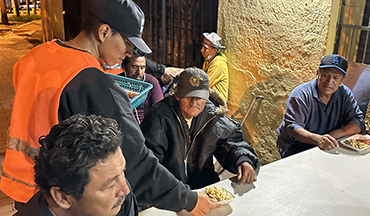
Kenedy (photo above serving food) has been trying to put into practice some of the things he has been learning in mentoring and serving others is very high up on his agenda. He finishes college this year and is keen on taking a gap-year with us and serving young people in the Centro Opp mentoring centre.
Our evening began by preparing tables and chairs in the street for the serving of food and then the leaders began with a time of worship and a bible story. Those gathered for a meal joined in with great enthusiasm and seemed very touched by the message before the meal was served.
My eyes were drawn into a few people who were not engaging in the activity. A boy, around 8 years-of-age, came and watched and one could see that he hadn´t eaten much that day and was standing at a distance watching the food being served. Thankfully one of the volunteers invited him to sit and eat and he did so with great enthusiasm, while at the same time was being vigilant to what was happening all around him.
I was not close enough to speak to him due to me now sitting across the street with two homeless guys. One lost interest very quickly as a taxi driver, obviously known to him, handed him a phone and I could see that it was his family calling him to check if he was OK. This left me alone with David.
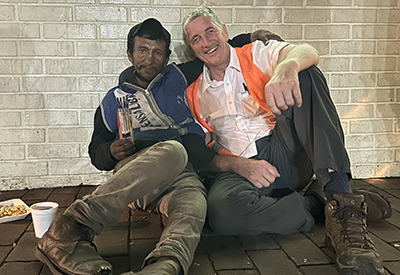 David (photo right) was unable to walk and so crawled around and invited me to sit next to him and talk. As I introduced myself and he told me his name we both stared into each other’s eyes as it was clear we knew each other. I haven´t seen David in many years, probably about 10 years now, but his unmistakeable smile and voice reminded me of when I first knew him when he was a homeless 12-year-old and addicted to drugs.
Many years have gone by and there was lots to catch up on. David just kept hugging me and telling me he has missed me and wanted to know all the things I had been doing and then went into great detail as he told me about mutual street friends and who was still alive and who is doing what and where they now sleep. It was a very special time and one that really blessed the both of us.
Later that evening I receive a message from a friend of mine who works in La Terminal and wanted some advice about what we could do to help a 12-year-old boy who was in need of support and possibly a short time in the Protection Home. We needed more information and so this took us into Sunday which is when I was able to respond to the plea for help.
The boy was not in immediate danger and so I could continue with the day´s activities of mentoring and then head to La Terminal later on Sunday evening to find out where he is and more about his situation.
I walked down the Quinta (5th Street) and found him with his sister, two younger brothers, his mum and dad, all sitting on the streets just watching life go past. The mum got up now and again to make tortillas for various people who came by to get their supply for their evening meal. Tortillas are the staple food here and an important part of every meal.
Joshua saw me coming and a huge smile grew across his face as he hugged me and buried his face into my chest. He is small for his age and his two younger brothers joined in the hug and this made his mum and dad stand up and greet me. His parents, obviously knowing the reason I was visiting, started by telling me “Yes we hit him because he doesn´t do what he is told and doesn´t complete his homework”. I am now trying to work out what is going on from what I see, what I know and also the years of experience in working with this family.
It is clear his parents are frustrated and when they are like this they resort to the standard response with their children and that is to beat them. Two of Joshua´s siblings are already in care, for the same reason, and it now seems to me that he will be heading the same way.
I ask his parents for permission to sit on the street corner and speak with him and they nod and return to watching the world go by. Joshua skips alongside me and climbs up on a wall and taps his hand next to him, indicating where he would like me to sit.
There are no opening questions as he begins to tell me, without stopping for breath, what he thinks of his parents and how badly they treat him and how much they are beating him. He lifts up his t-shirt to show me the bruises on his back and turns his head around to show me the other side of his face, which was purple with bruises he says and then points to other injuries and continues to say how he is feeling and not holding back on his colourful use of the Spanish language. The next bit leaves me staring into his eyes as he tells me three times of his father´s threat to kill him if he doesn´t do what he is told!
At this point his little brother climbs up on the wall and sits next to him and tells me that Joshua is being beaten and this brings tears into Joshua´s eyes which, in turn, makes his little brother reach out his arms and hug him. It is all rather moving and overwhelming.
Joshua then goes on to tell me that a lady across the road befriended him and offered him somewhere to sleep last week as he was not willing to sleep at home anymore. This annoyed his parents also, who later told me they didn´t like the idea of Joshua sleeping in a place that is also used for prostitution.
Clearly the situation is not great and I know that we have more of a picture of what is going on to act and offer him an alternative. What that alternative is will become clear later today. But just being here and being around means that Joshua, like so many boys his age and of similar circumstances, won´t need to take the street option. We have a much better system in place now to respond to all manner of situations and prevent more young children heading the way of the street, like David did when he was 12.
We sit in silence for a while and I think about the parallels between the lives of David and Joshua and how one life can still be changed now to prevent another child heading the same way as David did when he was 12.
Duncan Dyason is the founder and Director of Street Kids Direct and founder of Toybox Charity. He first started working with street children in 1992 when he moved to Guatemala City and founded The Toybox Charity. His work has been honoured by Her Majesty the Queen and he was awarded an MBE the year he celebrated working over 25 years to reduce the large population of children on the streets from 5,000 to zero. Duncan continues to live and work in Guatemala City. -
Tuesday 29th August 2023
The last few weeks have been particularly busy with the Camino por Amor walk, which was a tremendous success and not only raised funds for the projects we partner with, but also has created a tremendous affinity from the children to the projects they are supported by.
A huge thank you to all who supported in any way and to everyone who donated online. The appeal page is still open till the end of September if you would like to support.
Today I would like to talk about education. In Guatemala, like Honduras and so many countries in Latin America, education is a poorly funded sector. Despite the government here making some investments in the structural improvements to some schools, the gap between what is urgently needed and what is being offered is huge.
USAID report that only 68% of all children who enrol in their local primary school actually finish their schooling. The older the children get the worse the statistics are, demonstrating that only 10% of students make it to secondary school actually complete their studies.
Those who have the resources do very well, can attend the illustrious private schools in the capital and enjoy a top-rate education, which invariably leads to studying in a university in a western country. Sadly, those on the other end of the scale struggle to benefit from what is published as “free” government education.
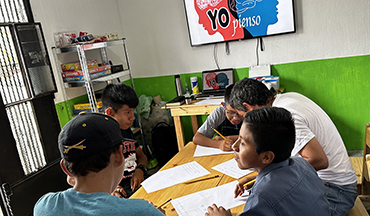
One of the main pillars of the mentoring programme, after targeting the most vulnerable children at risk of street life, is to get them into full-time education. Yes it costs in terms of the time it takes the team to convince parents to allow their children to go to school, visiting the schools and helping them understand the specific needs of our children and then to help to motivate the children daily to keep studying. Furthermore the mentoring centres are one of the few places the children can go to get help with the mountain of homework they are given.
I have had to collect many children over the years from their homes/shacks, get them up and ready, give them breakfast and take them to school. This is now done by the team and I realise the commitment that this takes for the first couple of weeks of the school year to get kids used to the rhythm of going to school, but it’s a commitment we have to make in order to help kids realise the potential of education to change their lives.
With 42% of the population of Guatemala made up of the Mayan indigenous people groups, the need to bring education to them is even more of a challenge. Since 90% of the children in our programme are coming from these groups, we know how difficult it is to engage them in school, but we do and the success rates are far beyond those of the national average.
I reflect on all this as I sit opposite Damaris and her boyfriend Alexander in San Martin, a smart bakery in a trendy area of Guatemala City. I invited them for afternoon tea, a new concept for them both, but one they thoroughly enjoyed. The afternoon out gave me the opportunity to understand how they are doing with their young daughter and review their studies.
Both Damaris and Alexander are now studying with us and trying to make something of their lives despite them both growing up in huge poverty and neglect and living in very humble conditions across from La Terminal in Guatemala City.
What makes me laugh is looking at the photo I took yesterday and what was written in Alexander´s t-shirt (photo below). He was not aware of what it said and when I explained to him the text he too thought it was very funny as it is just the opposite of where his life is right now.
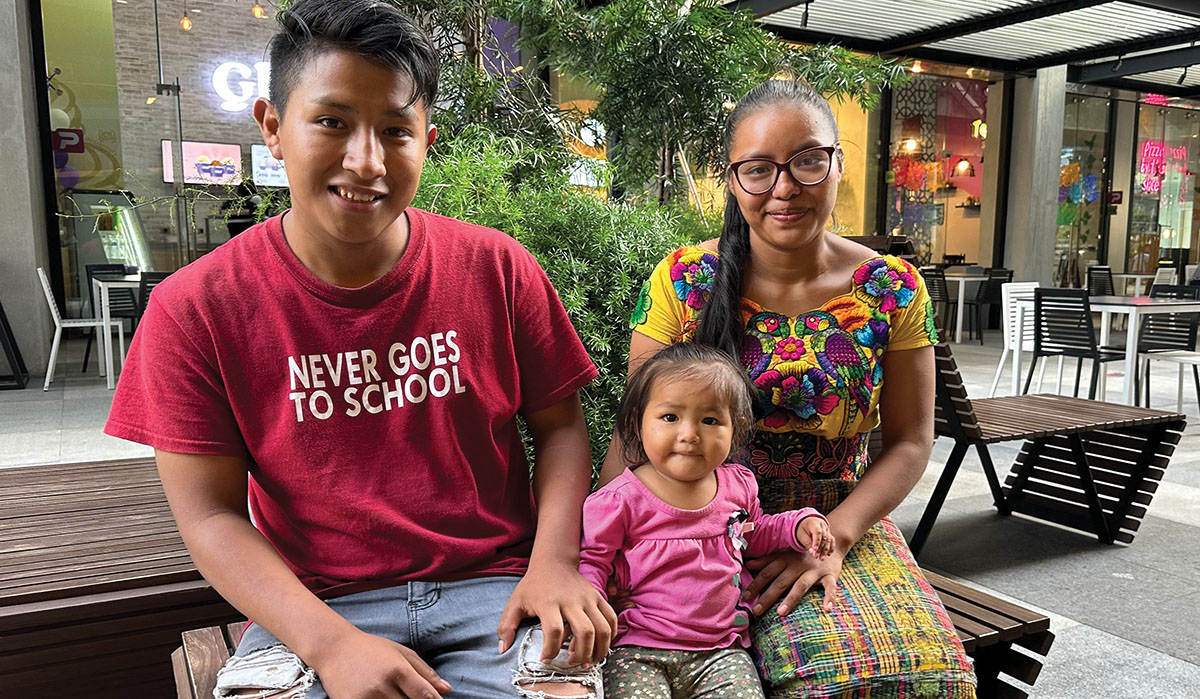
It seems only a few days ago that I sat with both of them at the end of 2022 and discussed education. Damaris had dropped out due to the baby being born and then of embarrassment at returning to our centre with a baby. Her culture is very different from ours and an unplanned pregnancy and one out of wedlock is not something her family or the elders would approve of.
It was easy to convince her of the need to return to studies as she was doing well before they had the baby and now she needed to ask permission from her 16-year-old boyfriend to return to the classroom. Alexander agreed and Damaris smiled and it was clear she was keen to keep going and even reach the end of secondary school one day.
The biggest challenge was with Alexander who had made it clear that he would not return to school or consider any form of education. He had done all he could to get to third grade in primary school, didn´t like it and was adamant that school was not for him. So the conversation had to take a different approach and I looked at their little daughter and could see he was besotted with her.
Learning to be a husband and dad at 16 takes a lot of support and and he needed a fair share of advice. It also brings with it huge amounts of new responsibility as before “I could just take off with my mates after work and play football”, he tells me. The transition from being a teenage boy to a dad was sudden and not one he enjoyed to begin with, but the role slowly grew on him and I have seen him mature so much over just a few months and I am very proud of all he has achieved.
I asked him what he wanted for his daughter and it was hard to stop him as he explained his dreams and hopes for her life. I asked if she would go to school and he said, “of course”. This was my opportunity to demonstrate to him how education could help her and him with the question “so what would happen when she comes home from school and needs help with her homework and you have to say you don´t know”. He went blank and then burst into tears. It hit home and the following week he messaged me and said he wanted to go back to school.
We are proud of all our kids and we know how hard it is for them to just get by. For them to succeed it takes a lot of their resources, energy, time and real grit. But they are achievers and I know will go on to great things.
No apologies for saying this again, but your support really does make the difference. Without it we could not be here, could not support the kids who want to make a better choice for their life, could not offer them the daily homework help they need and be there to go to school presentations and events and rejoice with them as they celebrate their school results. Our partnership is vital and you are appreciated. Thank you.
Duncan Dyason is the founder and Director of Street Kids Direct and founder of Toybox Charity. He first started working with street children in 1992 when he moved to Guatemala City and founded The Toybox Charity. His work has been honoured by Her Majesty the Queen and he was awarded an MBE the year he celebrated working over 25 years to reduce the large population of children on the streets from 5,000 to zero. Duncan continues to live and work in Guatemala City. -
Thursday 19th October 2023
Some days I see here the undeniable need for change in a society that has lost its way and where there is a silent congratulation for just existing one more day. With all that we are seeing of war, death and suffering around the world it is no wonder why one can feel helpless and even powerless.
Yesterday I walked with one of the young adults we have helped get off the rubbish dump to his humble home in the middle of Guatemala City´s largest developing slum, La Limonada. I first walked into this slum over 30 years ago when most of the now concrete structures were just tin shacks and where a highly contaminated river runs through the middle. The smell is often overpowering, but you do actually get used to it. The enormity of the place and its hidden need is what can make you feel helpless as very few Guatemalans would come down here.
The young man I was walking with I have known since he was 11 years-of-age and have seen a huge transformation in him over the years. From a kid growing up on a rubbish dump, doing drugs and involved in things that adults shouldn´t be doing, to now – being a great example of change. It was just fun walking with him and chatting about his life and family.
The reason for the visit today is to see his brother who is going through a tough time and needs some support. I have had him on my mind and heart for many months and have something I need to share with him that I feel God wants him to know about.
Walking closer to La Limonada you notice a change in the environment. The smarter cars are fewer, there are no police around and the feel of the place is increasingly oppressive. We walk close to the Ministerio Publico (Public Ministry) where there are a hundred or more protesters demanding the resignation of the Attorney General. The protests have grown substantially over the last three weeks and have resulted in blockades throughout the country. The shouts of the protesters can be heard all around as we begin to walk down the numerous steps into the far side of La Limonada.
I am somewhat of an anomaly here as it is noticeable that people stop and stare. A man sees me coming and grabs hold of his door and pulls it almost closed while keeping a close eye on me as I pass. A lady is sitting on the crumbling pavement and talking out loud to herself while pointing at the figures that she must be seeing in her head. We continue to walk down the many steps and the “aroma” from the river begins to arouse my senses.
As we near the bottom of the steps I find a man, probably in his late 30s huddled over a piece of tin foil together with a boy aged around 12. Both seemed to be getting high on crack and the boy leans further into the foil and lets out a groan. Two ladies say good afternoon as they hurry past and then I meet three men drinking alcohol on a corner and make myself known by making a big deal of saying hi to them.
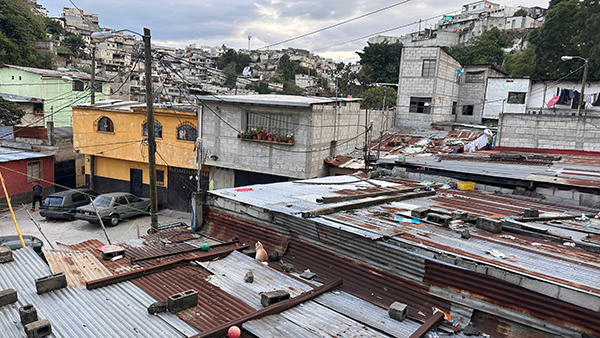 We walked into the alleyway where his house is and I am asked to wait until he ensures all is OK and I can climb up the few steps to see his brother. I wait and take a couple of photos while the dipping sun was casting its golden glow over the sprawling landscape.
I am now invited to come into his simple house and spend time with David. The last time I saw him he was 15 and had just become a dad and had decided to leave the local gang and try and make something of his life so that he can support his girlfriend and baby.
His smile is huge and infectious and I am pleased to see him too and we go inside and sit down, he on the bed and me on a plastic chair. A skinny cat rubs up against me and seems totally oblivious to its role in the home as a small mouse runs along the cable that hangs loosely from the ceiling and disappears into a hole in the block wall.
David was a lot of fun to be with and I first met him on the rubbish dump in La Terminal. He tells me he is nearly 10 and has a layer of dirt over his skin from working there in the heat of the day. His shabby clothes and rotting trainers were covered in rubbish. David smiled and then began to question me about who I was, what I was doing, why I was doing it and what I thought about the people on the rubbish dump. It was not long before he started appearing at our mentoring centre, which wasn´t yet open as workmen were working around the clock to try and get it finished before Christmas that year.
David always had that inquisitive nature and was always full of questions about why things were the way they were. I liked that and could see in him a desire for learning and so helped get him into school and could see he would thrive in an academic environment. The ups and downs of his time in school are something we can leave to one side for now as I know he has huge potential but seems resigned for now with drugs, stealing and sleeping during the day.
My message to him had been burning in my heart for many weeks and when I started to tell him what I had on my heart, tears began to stream down his face. He could see himself, as in a mirror, that the person he was now was not what he dreamed of when he was 10. I am now hoping he will work with us and go into a rehab centre as I know his potential is huge. It´s like I see him in an environment he was never meant to be. I feel so strongly he is destined for greater things and leave, after praying for him, and begin the climb back up the hill.
There was only one gun shot that rang out across the slum as I walked back up and then stopped at the top to take a photo. The sun was now setting but there was enough light for one photo and time to just look and think and appreciate what I have and then begin the long walk back home.
It´s not the safest place in the city and Sony, the SKDGuatemala Director, wrote to me later when I let him know I was home safely with the words “wow, that is a very dangerous place”.
The danger is never an issue, it´s the sadness that gets you. The hauntingly poignant image of that boy groaning as the drugs hit him will stick with me for a long time. I, at least, can go home to a place that is safe and I know that no one will break in during the night and where I won´t see children on the streets doing drugs or wandering around lost and without hope. I know the team here will do all they can to help David and I am hopeful that my parting words will have had an impact. There is still lots to do!
Duncan Dyason is the founder and Director of Street Kids Direct. He first started working with street children in 1992 when he moved to Guatemala City and founded The Toybox Charity. His work has been honoured by Her Majesty the Queen and he was awarded an MBE the year he celebrated working over 25 years to reduce the large population of children on the streets from 5,000 to zero. Duncan continues to live and work in Guatemala City. -
Thursday 11th July 2024
As dawn's first light touches the mountains encircling Tegucigalpa, I enjoy a cup of tea in the safety and quietness of the WGM Guest House. The day's adventure looms ahead, promising not just a scenic, hour-long drive to Talanga but an immersion into the profound and transformative world of Proyecto Alas. This remarkable ministry works with 68 high-risk children. It is directed by Steve and Lindsey Poulson, the visionaries who’ve been the backbone of this vibrant outreach in Talanga for the last seven years.
En route, we'll stop at two long-time projects that have become near and dear to our hearts over the years. Watching these initiatives flourish and evolve has been nothing short of extraordinary.
Our first stop is at a fantastic project dedicated to boys who have been rescued from the harsh realities of city streets. Love is more than a word; it’s a way of life in the Micah Boy´s Home. These boys find care, support, and inspiration to unlock their fullest potential.
The second project is equally transformative. It focuses on educating children who spend their days working in the city’s rubbish dump. Amidst the rubble and refuse, hope has been sown into their lives through education and the commitment of the workers and volunteers who believe change is possible. This project empowers these young minds, offering them the key to a brighter and more promising future.
As we journey through the winding roads to Talanga, the anticipation of witnessing these life-changing programmes fills me with a sense of purpose and excitement. Each visit reminds me of the incredible impact that dedicated, compassionate outreach can have on the lives of those who need it most and the difference even the smallest of donations can make.
Flashback to yesterday—a day that can only be described as purely magical. I spent time with a group of young adults who once knew the brutal realities of street life but now have grown into confident and caring adults working hard to achieve their dreams. Their lives epitomise the relentless dedication and love poured into them by Steve and Lindsey. Watching them grow from street-savvy kids to competent young adults was an emotional experience I am reflecting on this morning as I write this.
Many of the young adults we’ve supported have embarked on remarkable journeys. Some are now thriving in university, two have become dedicated police officers, and another has joined the army, showcasing their commitment to serving and protecting their country. One impressive individual has even landed a role with the FBI. Several others are future healthcare heroes, currently studying in medical college, while others have pursued careers that align perfectly with their unique talents and passions.
One particularly inspiring encounter was with a young man I’ve seen transition from life on the streets to working within the Municipal Government. He's now responsible for coordinating the city’s gardens and parks, demonstrating his transformation and dedication to creating beauty and order in the urban landscape.
Each of these incredible young people serves as a poignant reminder of the profound impact that steadfast support and unwavering dedication can have. Their stories are not just victories for them individually but a testament to the long-lasting difference your support continues to make here in Central America.
In the afternoon, I spent time with one young man whose story continues to move me profoundly. His journey has been a battle for survival, and as he retold his story to me, I was deeply overwhelmed by his resilience to keep going despite all he has had to navigate alone. I vividly remember him at eight years old, a fragile boy trying to articulate the trauma that led him to a depressing life on the streets. Each tear he shed came with painful insights into the brutal realities and abuse he endured during his time sleeping on the city streets.
Throughout the years, we’ve done everything we can to provide him with care and support despite his sometimes difficult choices. Yet, through every trial and setback, one unwavering truth has kept him moving forward: the knowledge that we and God genuinely love him.
Yesterday, he struggled to share the full extent of his suffering. If I am honest, it wasn't easy to hear. It was a crucial step for him, as he found comfort in releasing the deep pain he had carried inside for so long. Today, he returns to his university studies in social work, driven by a genuine passion to dedicate his life to helping vulnerable children who are walking a path he knows all too well.
His determination to transform his pain into a beacon of hope for others is nothing short of inspirational. Witnessing his journey from a heartbroken child to a committed young social worker reinforces the immeasurable impact of unwavering love over the last sixteen years.
It feels so good to be back! The familiar sights, sounds, and faces remind me how much I missed my life here in Central America. The past three months on sabbatical were a necessary pause, a time to recharge and reflect, and I’m honestly returning with a renewed sense of purpose and invigoration.
There’s so much I’m eager to share about my journey—a tapestry of experiences and insights that have enriched my life and deepened my calling. But this morning, my heart feels full as I walk alongside those who profoundly benefit from your continued support.
Reconnecting with these incredible individuals, witnessing their growth, and sharing their gratitude is a powerful reminder of our impact together. Thank you for being part of this journey. I’m thrilled to be back and even more excited about the road ahead.
Duncan Dyason is the founder and Director of Street Kids Direct and founder of Toybox Charity. He first started working with street children in 1992 when he moved to Guatemala City and founded The Toybox Charity. His work has been honoured by Her Majesty the Queen and he was awarded an MBE the year he celebrated working over 25 years to reduce the large population of children on the streets from 5,000 to zero. Duncan continues to live and work in Guatemala City. -
Saturday 29th April 2023
Walking down one of the busy roads in La Terminal in Guatemala City will take you past hundreds of stalls, most selling flowers, fruit and vegetables. It is noisy and often messy under foot as the thousands of daily visitors help generate over 3 million pounds worth of transactions per day. Built in the 1950s as a hub for the rural bus network to connect with the city centre, La Terminal has grown into the largest market in Central America.
It is here we work and where our first mentoring centre is situated. It is notorious for many things and certainly my afternoon and evening walk through the alleyways yesterday was not without its moments of risk, excitement, joy and challenge. Your eyes need to be open to what is going on as so much happens that your mind often struggles to take it all in.
I am visiting three of the children who have been in the mentoring centre this week and I am wanting to see how they are doing.
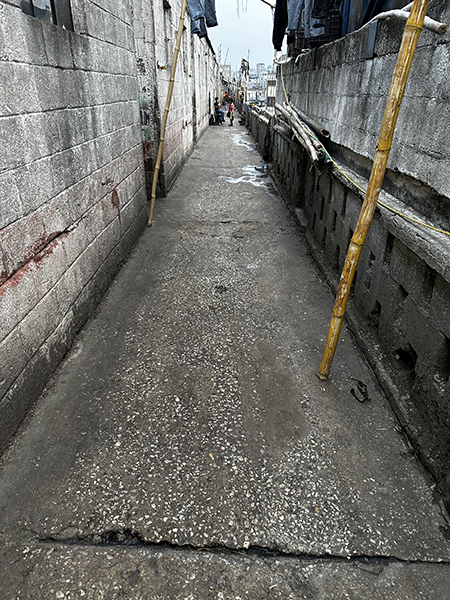 I come to the point in the 4th street where it becomes lighter and the street wider and you can almost be forgiven for not noticing the small metal door between two shops. It is half open and is dark inside, but as I walk in and up the steps I come to the upper level where hundreds of people live in squalid conditions, surviving in tiny concrete rooms with no windows, no bathroom and very little ventilation. The corridors are full of children playing, running up and down and enjoying their childhood as only children can.
As I get to a corner two children run out and meet me. Little Estuardo is holding up his arms and wants, as always, to be picked up and hugged. He is getting heavier now and soon is leaning back and looking into my eyes and asking me how his new mentor is. His sister introduces me to their cousins, two young identical twin boys. The mum now hears I have arrived and comes out of their room and smiles and asks how Juan Carlos (Estuardo´s new mentor) is doing.
Doña Flor, the mum, has fought hard over the years to keep her kids off the streets. It has been a battle and their new home is now farther away from the drug addicts that used to grace their doorstep, but it now comes with new challenges. Cooking is done outside in the corridor, toilets are for rent further down by the steps, together with showers, but it costs and every trip is another expenditure and over a week this starts to become quite a sum.
She was smiling and telling me about how much she had enjoyed the seminar at the mentoring centre today. She tells me how much she learned about how to manage money, the importance of saving, ideas of how she could generate a second income and the challenge to not fall into the various traps that are circulating around La Terminal that place people living in poverty in greater debt.
I leave and move on to visit another family. Leaving is not easy and takes time as the children ask for one more swing, one more hug, one more… well the list goes on.
I pop into see Carolina who had called me because she is distraught and needs to ask for advice. Out of the blue someone called her the other day and said they were a relative that was now living in the USA. It was clearly a scam but she was sucked into the story of a distant cousin who was coming back to Guatemala and was sending her a suitcase with phones and cash in and could she arrange to transfer him money to pay for the flight home. Slowly, and over three days, the caller convinced her to borrow money and send it because when the case arrived she would be paid back and earn so much more.
Carolina borrowed from here and there and made the transfer to the USA and then discovered that the suitcase hadn´t arrived and the number was now out of service. She was heartbroken as she thought she was helping her relative and was now facing years of paying back the £400 she had borrowed. She sat and sobbed and said she was more upset that someone had fooled her than thinking about the huge debt around her neck. She wished she could have seen what was coming and now has to re-build her life all over again.
Just a few hours or wandering around La Terminal and spending time with two families opens my eyes again to the reality with which thousands of people navigate each day. When you are living in poverty your options are few and every decision you take can lead so quickly to further poverty, abuse and pain or can slowly lead to growth and freedom. I know the team here work hard every day to bring more people along the path of freedom, walking with them and helping them make the best decisions they can to keep their children off the streets, out of gangs and in education.
Duncan Dyason is the founder and Director of Street Kids Direct. He first started working with street children in 1992 when he moved to Guatemala City and founded The Toybox Charity. His work has been honoured by Her Majesty the Queen and he was awarded an MBE the year he celebrated working over 25 years to reduce the large population of children on the streets from 5,000 to zero. Duncan continues to live and work in Guatemala City. -
Monday 18th September 2023
I was reminded yesterday of one of the outcomes of the mentoring programme when Linda, a visitor from the UK, and I dropped 5 excited boys home after a mentoring session at the CasaClub centre in Santa Faz, Guatemala City.
Like many first-time visitors to Santa Faz there is the challenge of walking back up the mountainside afterwards, as the altitude and numerous steps really take their toll on even the fittest of folk.
The last child to be dropped off is 10-year-old Jefferson, who lives with his large family in a tin shack on the mountainside. His innocence and gentleness has won the hearts of the other boys in the group he is in for Sunday mentoring, as he was the last one to join the established group and I wondered if he would be accepted and understood by the other boys.
One thing I have seen over the years is how isolated so many of these families are, despite them living near each other. Trust is not easily won in Santa Faz and given the violent history of the area it is no wonder why many work hard to keep themselves to themselves.
This past week has been extremely violent with 5 young people being killed over a 24-hour period, the last one a 15-year-old boy shot right behind our mentoring centre. Growing up here is not easy and every child will tell you of the latest killing like they are telling you that it rained yesterday.
Jefferson spends his time playing in the dirt outside his shack when he is not in school and was too shy to make friends or trust in others locally. Today, however, is different and a pleasing sight to see as one of the boys in the group calls round Jefferson´s home not long after we had dropped him home.
Linda and I were still with Jefferson´s family as I needed to check on the health of his younger siblings due to a huge increase in dengue fever. Linda was quite taken with the family and they proudly showed her their new cooker. They have never had a cooker before and have been saving up for a long time and got a second-hand gas cooker and connected it to a small gas cylinder. It has changed their lives and the children tell us that their food doesn´t smell of smoke now when they eat it.
The discussion about the benefits of a gas cooker stopped when Jose Antonio arrived. He is also 10 and is in the Sunday mentoring group. I have been concerned for him for the last two years as he spent increasing amounts of time on the streets due to his mum working long hours and not being able to get home in the afternoon to let him into their tin shack after school. Thankfully that situation has dramatically changed and now his parents are back together and he is much more stable and wanted to invite Jefferson to his home to play.
This is a new concept for many of the children but one that we are used to in the UK as kids invite their friends around to play after school or stay for sleep-overs. Here in Sana Faz the fear of others tends to prevent such invitations and children get used to isolation.
But the new friendships that have been developed in mentoring are breaking down those barriers and helping the children see that trust in others is possible and so Jefferson, with a huge smile on his face, is given permission to head off with Jose Antonio and his mum.
I watch the two boys climb up the mountainside and you can see the joy and contentment and one can´t help feel proud. Friendships like these are not easy to build but I can see so many more discovering that having trusted friends is a good thing and is another one of the developmental assets we hope to see the children become stronger in over the next few years.
Duncan Dyason is the founder and Director of Street Kids Direct and founder of Toybox Charity. He first started working with street children in 1992 when he moved to Guatemala City and founded The Toybox Charity. His work has been honoured by Her Majesty the Queen and he was awarded an MBE the year he celebrated working over 25 years to reduce the large population of children on the streets from 5,000 to zero. Duncan continues to live and work in Guatemala City. -
Friday 26th July 2024
My early years unfolded across the picturesque landscapes of rural Kent, Sussex, and Buckinghamshire. Our family relocated every two years, a rhythm dictated by my father's profession, making it challenging to establish deep roots or long-lasting connections. It wasn’t until I journeyed to Guatemala that I finally found a place I could truly call home.
When I speak of “home,” I understand it may resonate differently for others. For me, perpetually moving every couple of years made “home” a transient concept, more associated with people and experiences than a physical location.
Upon settling in Guatemala, I continued my nomadic lifestyle, albeit with a sense of greater purpose. The first significant landmark was acquiring our initial Mentoring Centre. I lived there, pouring my heart and energy into its renovation and operation for several enriching years. Next came another vacant building destined to become a haven—a Protection Home and a second Mentoring Centre. As the tireless efforts of builders gradually transformed it, I found myself shifting from one room to another, embracing the dust and noise as symbols of steady progress.
Throughout these transitions, close friends emerged as blessings, helping me secure a deposit for an apartment in the city—an oasis of tranquillity after all those nomadic years. I now find myself settled and enjoying a place I can truly call home.
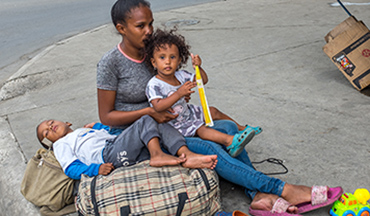
I am acutely aware that “home” remains an elusive, transient concept for the many families we work with in Guatemala. For them, home may be a modest tin shack or even the cold, hard steps of a shop entrance—a harsh reality I encountered just this week. One family, in particular, struck a deep chord with me. They were embarking on a perilous journey toward the United States, fleeing the desperate circumstances of Venezuela. Their faces etched with determination and fear, they navigated the arduous path through Central America, clutching onto the fragile hope of the American dream.
The image of their young son, barely five years old, burrowing under a flimsy sheet of cardboard with his parents to settle in for the night is etched in my memory. Their plight is not unique but represents a growing multitude who now find themselves residing in Guatemala City’s central zone, Zone One.
As I observed this family and countless others, an unsettling question haunted me: surely there must be a more humane way to live? How can we, with the abundance of resources and kindness that God has bestowed upon us, allow these conditions to persist? In moments like these, my heart aches with a mixture of sorrow and righteous indignation. It is a poignant reminder that we must try and do more.
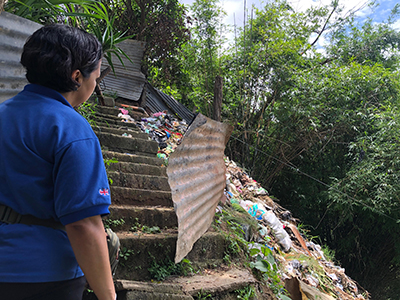 In that moment of reflection, my thoughts drifted to a family I have known and worked with for many years—a family that includes a young boy I had the privilege of mentoring for about five years. This week, our team visited them after I had been trying tirelessly to track down their whereabouts. They had lost the modest house they were renting, unable to keep up with the payments. The photos from that visit told a heartbreaking story.
This family bears the visible and invisible scars of a lifetime of trauma. Their existence is one of constant struggle, loss, and pain. They have endured suffering, hunger, and poverty that have left them broken and disheartened. And yet, amid this turmoil, there have been occasional glimpses of joy—moments shared with us that brought smiles to their faces and temporary respite during their stays at our Protection Home.
The juxtaposition of their harsh reality with these fleeting moments of happiness calls to mind the profound human capacity for resilience and hope. It challenges me to question what more we can do and how we can be instruments of God’s boundless love and compassion and extend our hands further, offering more enduring support.
The mother shared with us that a family member had offered them a plot of land on which to build their home. However, this so-called offer felt like a cruel irony. The land, already deemed uninhabitable, precariously hangs above a contaminated river, its foul stench making the environment almost unbearable.
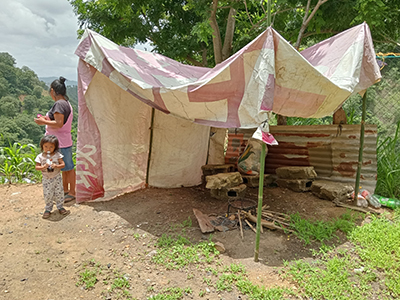 The family has asked for our help, and we are determined to do what we can. Our immediate goal is to buy some sheets of tin and lengths of wood to sure up what they already have and improve their little kitchen and dining room (photo left). While it may only serve as a temporary solution until a better alternative presents itself, it will provide them with some semblance of stability. Despite its shortcomings and challenges, it is a place they can call “home”.
If you feel moved to assist in any way, we welcome your generosity. Please follow the link below to make a donation. I assure you that every contribution will go to helping this family, providing them with the essential materials they need to build a safer and more dignified living space.
Tonight, I lie in the comfort of my own bed, and sleep will not come easily. My thoughts will be drawn back to that family and the poignant image of the young boy crawling under a flimsy sheet of cardboard. This stark contrast between their lives and mine is a powerful reminder, constantly putting my daily concerns into perspective. It reinforces my deep sense of gratitude for all that I have—shelter, safety, and the simple luxuries that I can easily take for granted.
I am also profoundly grateful to you—for taking the time to read this, for caring, and for being willing to extend a hand of compassion and support. Your willingness to help makes a world of difference for these families and countless others who find themselves in similar situations.
Duncan Dyason is the founder and Director of Street Kids Direct and founder of Toybox Charity. He first started working with street children in 1992 when he moved to Guatemala City and founded The Toybox Charity. His work has been honoured by Her Majesty the Queen and he was awarded an MBE the year he celebrated working over 25 years to reduce the large population of children on the streets from 5,000 to zero. Duncan continues to live and work in Guatemala City. -
Saturday 10th February 2024
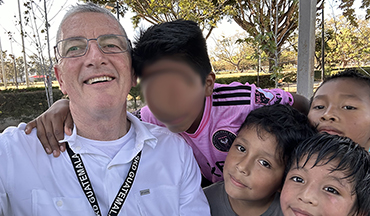
Javier (photo: pink football shirt) is 10 and last week I was with him in the mentoring centre in Guatemala City and commenting on his really cool football outfit. His matching shorts and shirt together with his football socks made him look like a real pro. I have known Javier since he was a baby and seen him grow up in the most challenging of circumstances.
Today he was happy and gave me a huge hug and told me how much he was looking forward to us all heading off to the local park to play football. Football was his passion; it was his life and it continues to be his outlet for how he feels about the rest of his life.
Getting children involved in sports is not only good for their physical fitness, not only good at stimulating the production of endorphins that makes them feel good, but is a social activity that forces them to mix with and develop relationships with others.
Javier was buzzing and couldn´t sit down. He wanted to leave right away, but we had to wait half an hour until all the other children had arrived and we could make the count, line them up, run over a few norms and then head off for the 10-minute walk to the park. Today, he just had to be the boy who carried the football as he was keen to show us his tricks.
While we were waiting I asked him to sit next to me and tell me how he was doing. I hadn´t seen him for a few months, due to being in the UK for the Radio Christmas project, and was wanting to tell him how much I thought he had grown in that time. Kids love that, but it was true, he had shot up quite a bit and he smiled and looked down at his trainers.
I asked him again how he was doing and watched as he struggled to answer. He tried to open his mouth but it seemed like something was taking away his words and he concentrated more on his trainers. I left some time for him to think and feel and as I did he began to cry.
I was not expecting tears. He seemed so happy about playing football. But the reality of his world outside the mentoring centre must have come crashing back into his little mind and the emotion of it all also flooded over him as this wave of hurt, pain, suffering and rejection made him shake a little.
“That´s OK”, I told him. “Sometimes it is good to cry and get it out”. His football shirt was now being used to cover his face as he wiped away his tears and sniffed a bit and then started to speak. His main reason for being upset was that he missed his older brother and sister. They had both left separately for the US over the last few years and had gone through quite an ordeal to make it to the border alone. They both now live with distant family but had been calling a lot recently saying they were unhappy and could they come home.
Because they had gone to the US he had to step up and help his mum run the family business of selling clothes in the streets whilst looking after his 5-year-old brother, who is also attending the mentoring centre.
Javier talks about how hard he feels it is for him just to keep going each day. He talks about the place where he lives and the many prostitutes outside day and night and how it makes him feel unsafe. He sees many like his dad passed out in the streets, doing drugs or mugging people. At least he feels safe in the centre.
The situation is complicated and the extreme abuse, neglect and suffering that his brother and sister went through before they left would make even the hardest person break down and cry. Now it´s up to him and he feels the weight of it all upon his 10-year-old shoulders. Sometimes he just needs to come in and cry and then he can cope again.
He hugs me once more and I stand up and encourage him to get to the front of the queue for football. Half an hour had passed and we had shared a special moment. He kept looking back and smiling at me as we walked to the park in the afternoon sunshine and upon arrival at the park was keen to show me his talents.
Javier is one of so many kids who just need that special time now and again and I am so proud of the team at the centre as I know it is not easy to be there day-in-day-out for nearly 60 children. But they also have a passion and many skills and I just love watching them and seeing how they provide that much-needed therapy without even realising it.
Thanks to your support we will keep being there for them all and will continue to rejoice with the Javiers as they grow in resilience and become stronger to face all the world throws at them.
Duncan Dyason is the founder and Director of Street Kids Direct and founder of Toybox Charity. He first started working with street children in 1992 when he moved to Guatemala City and founded The Toybox Charity. His work has been honoured by Her Majesty the Queen and he was awarded an MBE the year he celebrated working over 25 years to reduce the large population of children on the streets from 5,000 to zero. Duncan continues to live and work in Guatemala City. -
Saturday 27th January 2024
Every time I visit the rubbish dump I leave with the same feeling of desperation. I look around at the clamorous corner of La Terminal where tons of rotting rubbish are piled up and the stench clings to you and invades your nostrils to where you can´t help but make the choice to breathe through your mouth not your nose.
There are about 25 families currently going through the rubbish in order to find tin, plastic and paper they can recycle. They also search for food, anything that can be put to one side and later cooked up for dinner. Young children both work and play here and are constantly looking around as they are aware of the dangers. Dangers come from the council JCB digger that drives in at speed to compact the rubbish and now again scoop it up and take it to a waiting truck. There is also the danger of drug dealers, gang members and others who could be a threat. There is a lot that the young eyes continually scan for while they stoop over the rubbish or invent games to play using what they have around them.
Today, however, I left with a feeling of hope. Why hope? Well, I was with an incredible team of volunteers who offer their time to work with Puerta de Esperanza (Door of Hope) – a ministry that SKD supports and one that reaches at-risk children and youth in La Terminal and surrounding areas.
I remember when this ministry started and remember meeting up with Jomara, the founder, to discuss her dreams and vision to start to help the kids on the rubbish dump. Since then the dream has become a reality and one that reaches about 250 vulnerable children every week. Not only is the Puerta de Esperanza ministry working with the kids on the dump, their contact with the children and the families here has led them to other areas nearby, where children live at huge social risk.
It is great not to have the responsibility for the work, just to come as a visitor, to watch, encourage and see what this incredible team of people do. They inspire me and knowing some of them, like Jacobo, confirms to me that this work is in great hands.
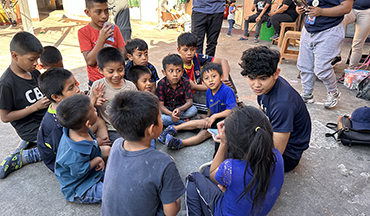
I have known Jacobo (photo above: leading the kids) since he was a small boy when I used to visit the dump with the street team. He lived in a tin shack opposite the dump and would spend hours sitting outside watching what we did and slowly would come and get involved in the activities. He is now part of the team and is such a wonder to watch as he works with the children.
For those who might have missed the video we made of their work for Radio Christmas, you can view it here.
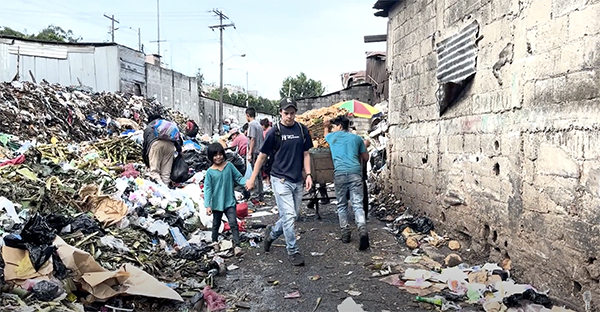
Some of the funds raised on Radio Christmas will go to help support this outreach during 2024 and I am sure that due to their work the feeling of desperation many feel who live and work on the dump will turn to hope and to change. Your support for this work really makes a difference and changes lives, thank you.
Duncan Dyason is the founder and Director of Street Kids Direct and founder of Toybox Charity. He first started working with street children in 1992 when he moved to Guatemala City and founded The Toybox Charity. His work has been honoured by Her Majesty the Queen and he was awarded an MBE the year he celebrated working over 25 years to reduce the large population of children on the streets from 5,000 to zero. Duncan continues to live and work in Guatemala City. -
Tuesday 6th August 2024
Yesterday, I received a heartwarming message from one of the mothers in our mentoring programme. She was overjoyed to share her son’s mid-term school results with me. She emphasised that the red marks on his report card were not a reflection of his failure but rather an indication that the teacher had not yet had the opportunity to grade his work.
Considering the adversity this young boy has faced, his results are nothing short of remarkable. I know firsthand that he grapples with understanding the assignments unless someone takes the time to explain them to him. Unfortunately, his parents are unable to provide the support he needs, making his daily visits to our mentoring centre invaluable.
It baffles me that teachers here continue to assign tasks requiring resources like specific websites, printers, and materials for cutting and pasting into schoolbooks. This boy’s reality is starkly different: He lives in a tin shack with a dirt floor and sporadic electricity. There’s no computer or printer. Each day presents an insurmountable challenge for him—one that he faces head-on. But thanks to the lifeline our mentoring centre provides, he has been able to take significant steps forward.
Today, I find myself reflecting on a particularly uplifting experience from Sunday. After church, I spent some cherished time with one of the boys from our programme. We had agreed to meet at a shopping mall he was familiar with, a place his mum had once taken him as a special treat. I didn't initially realise that this rendezvous required him to endure an hour-and-a-half bus ride.
Jared, now fifteen, has been part of our mentoring programme since he was eight. Living in the southern part of Guatemala City, Jared is no stranger to long bus commutes, which are a daily reality for him as he travels to and from school and our mentoring centre.
Jared’s family has deep roots in La Terminal, a sprawling market area in Guatemala City. For those new to my blog, La Terminal is the largest market in Central America, a bustling hub supporting thousands of families. These families' livelihoods are intricately linked to the market, where they engage in buying, selling, and various other support roles for stallholders. Tragically, this vibrant market life often coexists with deep poverty. Like Jared’s, many families rent small, cramped rooms and rely on communal showers and toilets for their daily needs, making their lives one of just existing.
I am impressed with the resolve of Jared´s parents, who committed themselves to working long hours, seven days a week, and saving as much as they could to put a small deposit down on a house for sale on the very outskirts of Guatemala City. Once their home was secured and monthly payments began, they moved as a family, knowing that the distance from La Terminal would help keep their children safe despite the long daily bus rides into the city, where their business of selling fruit on the streets continues to thrive.
Jared and his two younger sisters were identified by our street team as being at high-risk due to their dire living conditions and the significant amount of time they spent working on the streets. Many indicators were suggesting that without intervention, they might be headed towards making negative life choices that could ultimately lead to street life.
Our mentoring programme has provided Jared and his sisters with a haven—a safe, nurturing environment where they can flourish. Their parents were determined to give them the best education possible, searching tirelessly across the city for schools offering scholarships. This dedication resulted in Jared securing a place at the military academy near La Terminal.
Initially, Jared struggled to adapt to the academy's strict discipline, extensive study hours, and the demands of various military extracurricular activities. For even the smallest infractions, he often found himself kept back after school for extra rigorous physical training. Yet, despite these hurdles, Jared has shown tremendous resilience. Today, he proudly stands as the number two student in his year group—a testament to his unyielding perseverance and the supportive foundation provided by the team at the mentoring centre and his mentor – a Guatemalan man who works for one of the big brand car companies here.
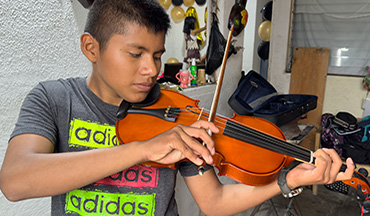
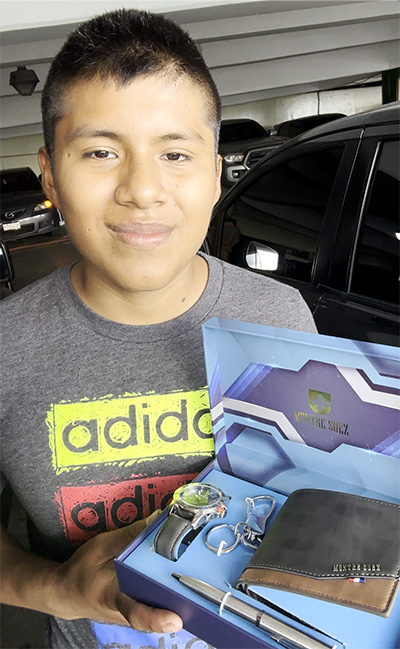 Furthermore, Jared has discovered a newfound passion that has brought an unexpected joy to his life—classical music. This year, through the encouragement of a teacher with whom he has formed a great connection, Jared decided to take up an instrument. Choosing the viola, he has dedicated himself wholeheartedly to mastering it.
Over lunch on Sunday, his enthusiasm was palpable as he passionately explained the different musical scales, the families of instruments, and the unique roles each played in an orchestra. He described how the music transported him to places in his mind, enhancing his ability to concentrate on his studies. With a gleam in his eye, Jared shared his dreams of travelling around Europe to immerse himself in its rich culture and musical heritage.
I've never seen a boy so electrified by the world of music. He couldn't stop talking about Mozart and the pieces he was learning. His excitement was infectious as he spoke about how his teachers had encouraged him to apply for a music scholarship with the National Orchestra of Guatemala later this month. Jared's newfound love for classical music has not only enriched his personal life, it has also provided him with a remarkable focus and clarity, further propelling him towards a bright future.
It's truly incredible to see how much Jared has transformed from the young boy I first knew, selling fruit on a street corner near the mentoring centre. His remarkable journey has been fueled by the unwavering dedication of his parents, his own determination to make better life choices, and the generous support of sponsors like Ken and Sue Harratt from the UK, who have been backing him through Global Care for the past few years.
Recently, Ken and Sue sent me money to buy Jared a birthday present. I enjoyed accompanying him to the shopping mall on Sunday to help him pick out something special and show him his sponsors' digital birthday card. His happiness was unmistakable, a vivid testament to the difference that support can make. Jared is just one of the many children celebrating their successes this week.
If you feel moved to sponsor a child in our mentoring programme in Guatemala through Global Care, you will receive regular updates through letters, reports, and photos. Additionally, we can arrange for video calls and messages via WhatsApp. Your support makes a profound difference to hundreds like Jared. Thank you.
Duncan Dyason is the founder and Director of Street Kids Direct and founder of Toybox Charity. He first started working with street children in 1992 when he moved to Guatemala City and founded The Toybox Charity. His work has been honoured by Her Majesty the Queen and he was awarded an MBE the year he celebrated working over 25 years to reduce the large population of children on the streets from 5,000 to zero. Duncan continues to live and work in Guatemala City. -
Monday 25th March 2024
Today we enter Holy Week and prepare for the Easter celebrations and the completion of Lent. It´s a time for reflection and for new beginnings and with this mind I reflect on the work in Guatemala and look forward to what is to come for us, as a charity, when I return from my sabbatical.
The word sabbatical comes from the Hebrew word `Sabat´ and means a break from work. My three-month sabbatical starts this week and it will be an interesting experience taking such a long break away from the work in Central America and focussing my attention on other things for a while.
For the last 32 years I have been working with the children and youth at risk in Guatemala and Honduras and can see how this work can impact upon one´s life. One can´t help but be affected, in some way, by the trauma of others. But, at the same time, I can honestly say that there is nothing more rewarding than feeling that a huge chapter is now being closed for me as exciting doors are opening and new adventures will soon begin.
On my return in late June to Guatemala, I will continue to live there, but my role will change quite dramatically as a new Guatemalan Board have now taken on the responsibility of running and caring for the SKDGuatemala work. God has provided an excellent group of committed and supportive people who will now administer the vision and mission and ensure we keep focussed on the needs of the children. I won´t be working so much with the children as before but will be looking to see how the development of our young leaders will help provide the first fruits of the greater vision to reach into other countries and impact the lives of the street-living children around the world.
I will be committed to developing a new global mapping strategy that will help us identify where in the world children are still living on the streets, how many are there and who is working with them. This will inevitably lead to global strategies to reduce the numbers of children living like this and help states develop programmes to ensure their protection and safety.
Leaving behind the children is not easy, but when I see how much passion the local teams have to their wellbeing and how committed they are to keeping them safe and helping them thrive, I am moved and thankful to God for so many Guatemalans who have now taken on the baton and are running a great race.
Our kids are survivors and don´t need to be reminded of where they and their families have come from, they know that all too well. We need to keep motivating them to see the bright horizon of possibilities and opportunities ahead and help them take the steps that will lead to growth, happiness and success.
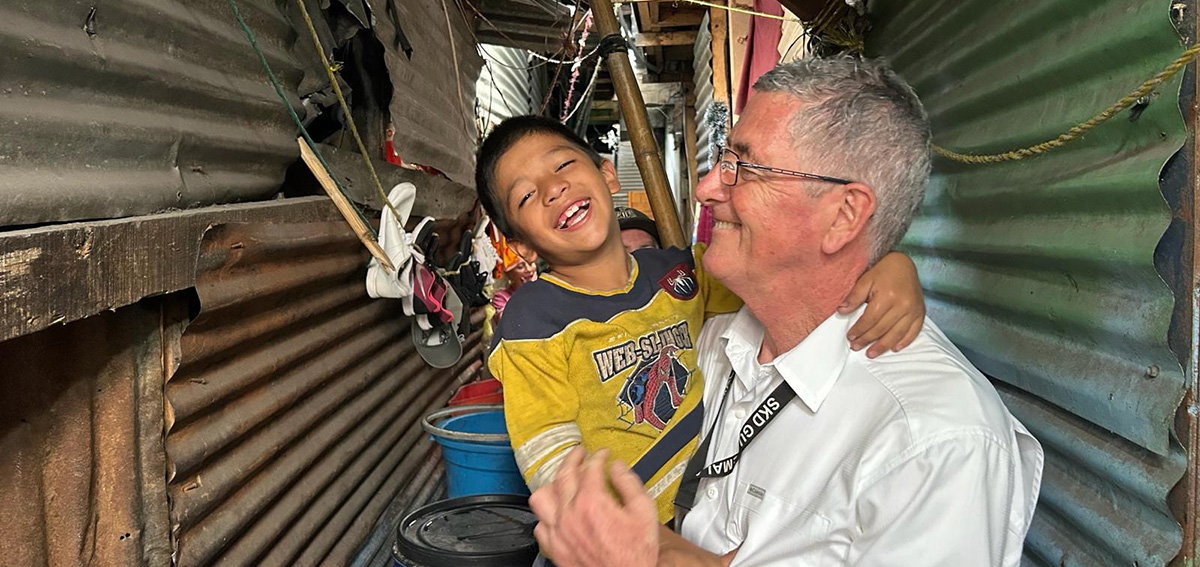
It is extremely humbling to watch the older youth / young adults who have grown up through the mentoring programme and who are now leading the children. One of them, 15-year-old Melvin, was telling me recently of how he feels he connects with the children. “No one can fully understand what each child has gone through and is going through” he tells me, “but we all know what it is like for us and we just know when a child needs a hug or needs to be left alone”. He is insightful and we talk further on the subject and how it is that we have never heard any of the children or youth even make fun of another child because they don´t have shoes, don´t have underwear, have a strong odour, or show signs of abuse and neglect. Melvin tells me: “We just know”, and it is this knowing that leads to some very special work. It is very emotional to watch this happen and to see the love that is transmitted between the older and young children.
I can now enjoy the break my mind, spirit and body need and know that when I come back all will be well and maybe even in a much better place – that would be exciting!
Thank you all for your prayers, for your messages of support and especially for your support which we will need even more in the coming months. Lives are being changed and I hope you will keep your eye on our social media feeds and be encouraged to see what your support is doing to reach over 650 vulnerable children in Central America.
Will catch you on the flip side in early July!
Duncan Dyason is the founder and Director of Street Kids Direct and founder of Toybox Charity. He first started working with street children in 1992 when he moved to Guatemala City and founded The Toybox Charity. His work has been honoured by Her Majesty the Queen and he was awarded an MBE the year he celebrated working over 25 years to reduce the large population of children on the streets from 5,000 to zero. Duncan continues to live and work in Guatemala City. -
Sunday 11th August 2024
As you walk through the bustling streets of Guatemala City, it's impossible to overlook the presence of migrant families. They are now everywhere—huddled in shop doorways or clustered in parks and areas under the watchful eyes of patrolling police. These days, an overwhelming number of these families hail from Venezuela, driven from their homeland by forces beyond their control.
Venezuela's crisis has become a river of humanity, nearly eight million strong, flowing into neighbouring countries. It stands as the largest displacement crisis in contemporary history. What drives this exodus? It's a heart-wrenching mix of an unravelling economy, democratic breakdown, political repression, and a harrowing list of human rights abuses. Crimes committed by organised criminal groups, including sexual violence, murders, disappearances, human trafficking, robbery, and intimidation, have painted their lives with fear and suffering, forcing them to seek refuge wherever they can. The UNHCR's reports are not just statistics—they echo the cries of real people searching for safety and a sliver of hope amidst the turmoil.
For many of these families, Guatemala is just a chapter in a longer, arduous journey to the perceived promise of the United States. This trek spans a staggering 4,300 miles and can consume six to nine months of their lives, assuming fortune and the kindness of strangers favours them. The road is fraught with peril, and not all reach their hoped-for destination. Some find a semblance of refuge within the countries they pass through, choosing to make these places their new homes. Tragically, some never complete their journeys, falling victim to mortality along the way. Those who do survive often carry harrowing tales etched into their memories—stories of abuse, robbery, rape, and kidnapping that turn their quest for a better life into a relentless nightmare.
This week, I gathered with an earnest group of volunteers from the Puerta de Esperanza ministry we support in Guatemala City. Together, we embarked on an evening walk through the streets of the capital, our mission clear: to meet migrant families and listen to their stories. Each tale mirrored the harrowing account of Leonardo, whose story echoes the anguish and resilience of so many others on this perilous journey.
I do not relay Leonardo's story to justify his choices or to advocate for illegal migration. Rather, I do so with the hope that his voice, and the voices of hundreds like him, will be heard. Perhaps, in hearing these stories, more people will be moved to take action, to offer protection and compassion, especially for the young children trapped in this inhumane quest for a safer life.
Three months ago, 28-year-old Leonardo and his family took the decision to leave their family home in Maiquetia on the northern coast of Venezuela and head for the United States. Poverty and the fear of further political repression from the Maduro government were significant factors in helping Leonardo to ask his family to join him on the perilous journey through Central America.
Leonardo's family consists of eight brave souls: his brother, sister-in-law, their two young children, his wife, their baby son, and a cousin. They embarked on their journey with hopeful hearts, knowing that once they crossed into Colombia, they would be met with kindness and care. In Colombia, they found sanctuary; generous locals offered them rides and donated money for bus fares and temporary shelter. But their fortunes took a dark turn when they left the safety of their Colombian hosts and approached the border of Panamá.
Between Colombia and Panamá lies a 70-mile expanse void of roads—the notorious Darién Gap. Unlike the tourists and adventurers who fly over this treacherous terrain to Panama City and continue northwards to Costa Rica and beyond by bus, migrants like Leonardo's family have no such luxury. They face the daunting challenge of crossing the Darién Gap on foot—a perilous journey through a formidable and dangerous jungle that serves as the dividing line between South and Central America. It's a journey fraught with risks, demanding every ounce of their courage and resilience, a test of their will to survive and press forward against all odds.
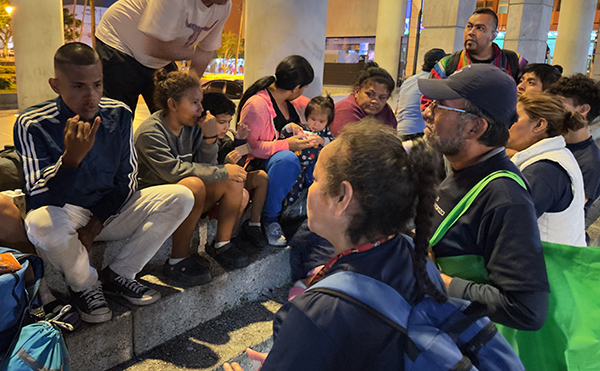 Leonardo tries to compose himself as he knows this part of the story is the hardest to tell. His wife seems to hold onto their 9-month-old baby even more while staring into the central park as she knows what is coming. Leonardo takes a deep breath and tells me about the family who they got to know on the way and travelled with them through most of the Darrién Gap. The family were hopeful they would make it to the other side of the Gap, even though they knew the risks involved from the elements and local gangs.
On the second day of their arduous trek through the dense jungle, after crossing a deep river, Leonardo's family encountered a harrowing turn of events. Emerging from the jungle, a group of armed men—some clad in police uniforms—descended upon them, separating families and seizing phones, money, and other valuables. Sensing the imminent danger, Leonardo quickly turned off his phone and hid it deep within his underwear.
The nightmare intensified as Leonardo's friends were herded into a particularly dense part of the jungle. The air soon filled with the sounds of cries, beatings, and, eventually, heart-piercing screams. An hour later, the ordeal came to a chilling end, and the family they were travelling with made their sorrowful way back towards Colombia. Their two-year-old daughter lay lifeless, her final hour too horrific to detail here. The group's spirit was shattered, and they walked in stunned silence for hours, passing many rotting bodies, before grief finally broke through, spilling out into tears.
Leonardo, making the sign of the cross over his heart, whispered a solemn belief that the little girl was now in heaven, cradled by God's arms. With unwavering faith, he prayed daily for a safe journey for his family, a prayer that carried them all the way to the borders of Guatemala.
As Leonardo recounted their trek, he painted a vivid picture of the desperation and poverty they encountered in Nicaragua. The faces of those they passed mirrored their own plight, a stark reminder of the widespread struggle still continuing in Central America. Crossing into Honduras, they were struck by an unexpected act of kindness—border officials, moved by their story, handed them money to help continue their journey. This small mercy stood out like a beacon in their long, arduous road, infusing them with a renewed sense of hope and the strength to push forward.
Returning from the central park to the Puerta de Esperanza centre, the distance gave us space to process the heart-wrenching stories we had just heard. It was a moment to thank God that we each had a bed to sleep in that night.
As we walked, memories of the early 1990s flooded back to me. I recalled the growing number of children on the streets, fleeing conflicts in other Central American countries. They had hoped to journey north, yet many ended up staying in Guatemala, with some tragically losing their lives here. Determined to prevent history from repeating itself, we resolved to find ways to respond and help the children caught in this tide of mass migration.
One thing became unmistakably clear during our walk home: we couldn't just stand by and do nothing. Our faith and shared compassion compelled us to act. Where this will now take us, God only knows.
Duncan Dyason is the founder and Director of Street Kids Direct and founder of Toybox Charity. He first started working with street children in 1992 when he moved to Guatemala City and founded The Toybox Charity. His work has been honoured by Her Majesty the Queen and he was awarded an MBE the year he celebrated working over 25 years to reduce the large population of children on the streets from 5,000 to zero. Duncan continues to live and work in Guatemala City. -
Saturday 7th September 2024
I still cherish the small picture frame my daughter gave me when she was seven, a gift she offered for no particular reason other than to demonstrate her love. The ornate frame features a hand-drawn message that reads, "The best daddy in the world."
While I can't claim that title, as many fathers are likely far better than me at navigating the complexities of parenthood, this simple gift serves as a beautiful reminder of the free and straightforward nature of children to express what they feel. Being a dad is no easy task; it comes with immense responsibilities and countless challenges.
Yet, in those moments when I doubt my abilities, the frame reminds me that love and effort count for a lot. Small gifts like this and the numerous paintings and drawings we are presented with as parents symbolise a child´s unwavering belief in an adult who tries their best to care, love and protect.
I was recently reminded of something that I felt God placed on my heart back in 1991, long before I made the move to Guatemala. It was a calling to be a father to the fatherless. Over the years, I’ve had the privilege of sharing this calling in numerous venues worldwide, telling audiences about my call and journey to Guatemala. Now and then, those exact affirming words are spoken back over me, reinforcing my mission.
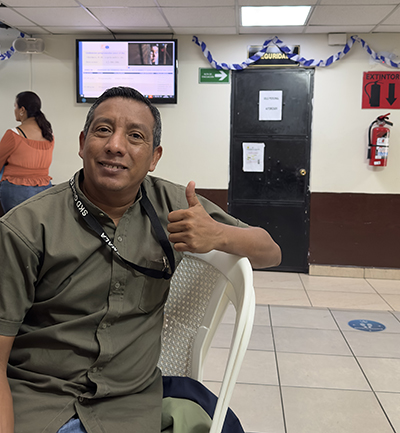 Yesterday, I was invited to the “Juzgado de la Primera Instancia de Niñez” (The First Court for Children) to present myself before a judge for an update on Moses, one of the boys we rescued. Moses now resides in an excellent children’s home in Guatemala City, a place where he receives the love, care and support he so desperately needs.
I was accompanied by Juan Carlos (photo right), who is always on hand to help advise on legal matters and be steadfast in his moral support.
Standing before the judge, I couldn't help but reflect on the journey that had brought me to this moment. When asked to explain my relationship with Moses, I found it challenging to condense such a profound and emotional story into simple words. Time was limited, so I focused on a poignant memory—the first day I met Moses.
He was just four years old, a small boy with wide, searching eyes. His mother, frail and weak, had tearfully pleaded with me to help Moses. She knew her time was short, only a few weeks remaining, and in her desperation, she begged me to take care of her son. Her plea was both heartbreaking and urgent, a mother’s final act of love and hope for her child’s future.
In that brief explanation, I wanted to convey the depth of my commitment to Moses. This wasn’t a matter of legal guardianship; it was a fulfilment of a promise—to be a father to the fatherless, as I had been called to be.
Moses appeared on a closed-circuit TV system from another room, seated beside a social worker who gently asked him about the people who visited him at the home. With a childlike sincerity, he spoke of his grandmother, cousins, and their children. Finally, he mentioned me.
The social worker encouraged him to elaborate on who each person was. My heart swelled as I listened, but it was when he spoke about me that I struggled to hold back the tears. Moses explained, in his innocent and earnest way, that while he understood I was his mentor, he saw me more profoundly—as a father.
Hearing him express this understanding reinforced why I was there, reminding me of the immense importance of the role I had taken on. It wasn’t just about mentorship or care—it was about family, love, and the unbreakable bonds that form when we answer the deep call within us to be a parent.
Moses was delighted at the end of the hearing as the judge permitted him to spend the school holidays with me and the team, which will be very good for his mental health and broader social development.
Later that evening, as I settled back home, the phone rang suddenly. It was Jonathan, his voice brimming with excitement. He wanted to share how delighted he was about his work experience. This is his final year of schooling, a pivotal time before he goes to university or steps into full-time employment.
Jonathan's enthusiasm was contagious as he breathlessly recounted his day, barely pausing to breathe. He marvelled at the printers he had used to create large acrylic banners, describing them with the wonder of someone who has found his passion.
Amid his energetic recounting, Jonathan took a moment to thank me. He reminded me of how I had been there for him since he was nine, playing a significant role in helping him and his family escape the perils of La Terminal. Together, we had navigated the journey to a new life, far removed from the gangs and daily threats that once loomed so large.
His life had truly transformed, and even though he had graduated from the mentoring programme, he knew he could always call and chat. Hearing his gratitude and witnessing his growth filled me with profound satisfaction.
Thanks to your unwavering support, we have been able to invest in the lives of hundreds of vulnerable children over the years. This morning, I visited the Street Kids Direct website to double-check our numbers and was deeply encouraged by what I found. Since we began in 2000, we have helped 5,285 vulnerable children find hope and a path away from the streets.
Your support truly makes a difference. It enables us to devote our time and resources to parent these children, providing them with the guidance and love they need.
Thank you for standing with us and making this possible. Your generosity continues to transform lives, one child at a time.
Duncan Dyason is the founder and Director of Street Kids Direct and founder of Toybox Charity. He first started working with street children in 1992 when he moved to Guatemala City and founded The Toybox Charity. His work has been honoured by Her Majesty the Queen and he was awarded an MBE the year he celebrated working over 25 years to reduce the large population of children on the streets from 5,000 to zero. Duncan continues to live and work in Guatemala City. -
Tuesday 1st October 2024
Last night, we received heartbreaking news: one of the young people who had been in our mentoring programme was tragically gunned down in front of a fast-food establishment near our mentoring centre in La Terminal, Guatemala City.
Jose, just 17 years old, was approached by someone who pulled out a gun and shot him multiple times. He passed away almost instantly and was identified soon after by his family, who lived nearby.
Jose's tragic death is a stark reminder of the ongoing violence that claims countless lives in Guatemala City each week. Despite a reduction in the overall homicide rate, there are still 42 violent deaths reported every week, and alarmingly, 40% of these victims are young people. Our hearts go out to Jose’s family and all those affected by this senseless violence.
When I received the devastating news of Jose's death, I had just spent over an hour driving home from La Terminal. Noticing an incident a couple of blocks ahead, causing a traffic jam, I decided to detour around the market. To my horror, on arriving home, I discovered that Jose was lying dead in the street, and this tragic event was the source of the traffic disruption.
Growing up in Guatemala City was fraught with difficulties for Jose. I vividly recall the first time I met him outside our mentoring centre. It was dusk, and we had just wrapped up our activities for the day. I noticed a small figure hiding behind my car on the street.
As I approached, Jose’s 8-year-old sister, Karla, emerged and started asking about our activities at the centre. Karla's smile lit up as I described our day’s events, and her relaxed conversation seemed to reassure 9-year-old Jose. Encouraged by his sister's interaction, he cautiously stepped out from behind the car to say hello. That moment marked the beginning of our connection with these two resilient children.
Both children (photo above in the mentoring centre) joined the mentoring programme that very week and soon began to relish the activities, often telling the team how safe they felt at the centre. Their childhood had been harrowing, and as they gradually opened up about the murder of their parents and their subsequent struggle for food and amusement on the streets, it became clear just how vital our support was.
As trust blossomed, we were able to enrol both children in school and provide them with the daily support they desperately needed. Living nearby with their grandparents, who were preoccupied with running a bar, left the children essentially on their own. The odds were stacked against them, and despite our intense investment in their lives, adapting to the world around them remained a constant struggle.
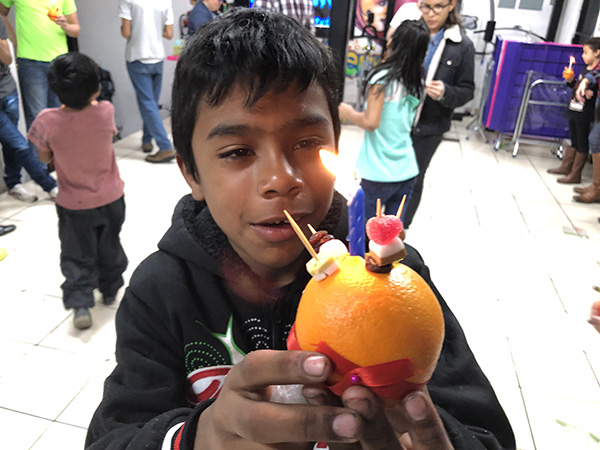 Sadly, Jose (photo right in happier times) was taken into care but repeatedly ran away, increasingly leading a street-connected life that put him at grave risk. We watched helplessly as his health and well-being deteriorated.
Earlier this year, Jose returned to the mentoring centre, attempting to fit in once again. Evidently, he was searching for a sense of belonging and connection—something that had always eluded him. Despite his efforts, the stability and support he so desperately needed seemed just out of reach. His tragic story is a poignant reminder of the immense challenges many young people face here and the critical need for continuous support and intervention.
Now, we find ourselves planning yet another funeral. Another precious life was lost. Another missed opportunity. And another child for whom we grieve deeply.
Last week, I sat down with a teenager who was facing a challenging time. Carlos needed support to complete a project for his final year at college. His chosen subject was communications, and he had to produce a 20-page colour magazine and accompanying publicity material.
Carlos had relocated to a town in northern Guatemala where internet access and support were scarce. As a result, he needed help to complete his college year since most of his coursework was now online.
Carlos, another product of our mentoring programme, had made positive strides in his life. He had made good decisions and was determined to build a promising future for himself. Despite the hurdles, his resilience and ambition shone through.
Carlos's journey was fraught with challenges. His uncle had set up a small business in La Terminal, and Carlos, living with his mother, would often help out after college to support himself and his mum.
Towards the end of 2023, Carlos witnessed two men threatening his uncle with demands for extortion payments. Unable to pay, the men returned with a chilling warning: if they didn't pay, both Carlos and his uncle would be killed. Terrified, Carlos fled the city to live with his sister in a small town in northern Guatemala. Just two days later, he received the devastating news that his uncle had been murdered.
Growing up in La Terminal is a harsh reality for most kids. Almost all of them witness violence on a weekly basis. The constant exposure to brutality, seeing family members killed or lost to drug overdoses, slowly conditions these children to adopt survival strategies that keep them alive. This relentless exposure fundamentally alters their worldview, normalising experiences that most people would find unimaginable.
Carlos's story illustrates the severe challenges young people face in such environments, underscoring the importance of our mentoring programmes and the critical need for ongoing support and intervention.
Carlos has successfully completed his project and can now return to the quiet town where, as he tells me, “Not much happens, but it is safe.” He will finish his college course and begin searching for full-time work, embarking on his adult life journey. Carlos is grateful to have made it out of La Terminal.
In stark contrast, Jose's life has tragically ended, cut short in his prime. The world has lost all the potential and talent he possessed. His untimely death propels us forward, reinforcing our commitment to make a difference. We are driven even more today to rescue more children, intervene before time runs out, and ensure their futures are not lost.
Duncan Dyason is the founder and Director of Street Kids Direct and founder of Toybox Charity. He first started working with street children in 1992 when he moved to Guatemala City and founded The Toybox Charity. His work has been honoured by Her Majesty the Queen and he was awarded an MBE the year he celebrated working over 25 years to reduce the large population of children on the streets from 5,000 to zero. Duncan continues to live and work in Guatemala City. -
Friday 11th October 2024
THE TALE OF THREE BOYS
The tale of three boys has come from reflecting on the past week's tragic events and how the lives of three boys illustrate the various elements of our work here in Guatemala.
BOY 1 – ALEX
Alex's childhood was marred by fear and uncertainty. He was often afraid to walk to school past the gangs and contract killers that ruled his neighbourhood. He shared a modest room with his grandmother and two sisters, as both his parents were incarcerated and unlikely to return until Alex reached his late teens. This small room, nestled on the third floor of a long-abandoned building, was his only concept of home, secured through his grandmother's resourcefulness.
Their precarious living conditions frequently led Alex and his sisters to the streets at night, inadvertently forming an attachment to a life that was fraught with danger. Then, one day, the Street Kids Direct (SKD) team approached them, inviting the children into engaging activities and, subsequently, the mentoring programme at the centre.
Alex thrived at the centre, taking on an active role and relishing the sense of community and support. But as he grew older, the lure of the local gang became more challenging to resist. Yet, despite the temptations, Alex made a courageous decision to turn away from that path. His rejection of the gang allowed him to start anew, find work, and aim to build a future for himself.
Upon hearing the devastating news of José's death, Alex joined his sisters and SKD team members in mourning his friend's loss. During this difficult time, Duncan spoke with Alex about his choices to carve out a new path for himself. Duncan expressed hope that Alex would find happiness and fulfilment after enduring years of poverty and countless challenges to survive.
As Alex sat next to his sister and José's sister's boyfriend at the funeral reception, the unimaginable occurred. Two gunmen burst into the gathering, aiming at Alex's circle of friends. They shot one of his friends dead, then tragically turned the gun on the boy's mother before firing at Alex and his friend Bryan.
At the time of writing this, both Alex and Bryan linger in a delicate state—stable yet critical—within the walls of the general hospital. Once more, Alex finds himself at a crossroads, his life precariously perched between hope and despair. His family clings to faith, praying tirelessly for his recovery and dreaming that he will emerge from this harrowing ordeal. They hold onto the vision he shared with Duncan—a life renewed, filled with the promise of happiness and fulfilment he so earnestly wanted before his friend José was gunned down in the streets.
BOY 2 – JOSÉ
From an early age, life had stacked the odds against José. After the tragic murder of his parents, he and his younger sister, Karla, were sent to live with their grandparents in La Terminal, Guatemala City. The transition was a difficult one. As they struggled with their grief, they were thrust into the harsh environment of La Terminal, where their grandparents ran a bar that stayed open from dawn until the early hours of the next day.
The absence of consistent parental care and adult supervision made their gradual drift to street life almost inevitable. José and Karla soon found themselves slipping away from education and the familiar networks that once provided stability. When I first met them, it was evident they were lost and desperately needed support, structure, and love.
The mentoring programme became a beacon of hope for them, offering an environment of care and compassion they enjoyed during their early years with us (photo right). Unfortunately, José began to distance himself and made choices that led him away from the programme's nurturing environment. This path eventually saw him placed in a government children's home, but he soon ran away and ended up back in La Terminal.Upon his return, José seemed changed. He had acquired street skills that both opened new doors and deepened his feelings of abandonment and loss. His pathway diverged from the safety and support he once experienced to a more feral lifestyle.
On Monday, September 30th, José made the fateful decision to cross the road to a fast-food restaurant opposite the bar where his grandfather worked and where he lived with his sister Karla. Tragically, within moments, he was gunned down, shot six times, and succumbed quickly to his injuries. The motive behind his murder remains unknown, yet it's another case that will likely go uninvestigated by police, who often avoid involvement in extrajudicial killings in La Terminal.
Having recently turned 17, José was known to be a generally quiet and polite boy. Burying him last Friday dealt a bitter blow to those of us who endeavoured tirelessly to embrace him with love and guide him toward a brighter and more promising future.
BOY 3 – MOSES
Last Sunday, I spent the day celebrating Moses's 17th birthday (article photo above). It was a joyful occasion that began at church. Then we went out to shop for a new pair of trainers and shared a hearty lunch. But amidst the laughter and festivities, a sombre task awaited me. I had to share the heartbreaking news that José, one of Moses's friends from the mentoring centre, had been killed and that another friend, Alex, was fighting for his life in the hospital.
The news hit Moses hard. Together, we flipped through photos of the funeral and reminisced over snapshots of José from happier days, full of life and joy at the mentoring centre. It was clear Moses needed a moment to absorb everything. As he silently reflected, his eyes moved from the plate of meat he had been enjoying to meet mine. At that moment, he expressed deep sadness and heartfelt gratitude for having been afforded a different path—a chance to break free from a fate that his friends could not escape.
"Did I ever tell you I was almost killed in La Terminal?" Moses remarked, pushing around the last piece of meat on his plate. His question caught me off guard, though I was aware of several harrowing situations he had faced, including the time his friend was shot in the head while Moses crossed the road to buy him a soft drink.
Moses's journey closely paralleled José's, as both had grown up facing the same daunting challenges. Knowing the rugged roads Alex and José traversed, Moses could easily have walked a similar path.
As Moses recalled his past, his gaze became intense, and he rubbed his hands together anxiously. He recounted a memory from years ago when he worked in La Terminal and sat with three boys, observing the world pass by. "For some reason," he continued, "I just stood up and walked across to the other side of the road."
At that very moment, two men on a motorbike sped by, one spraying his friends with bullets from a semi-Uzi. Frozen in disbelief, Moses eventually ran back, only to find all three of his friends had been killed.
"It could have been me!" he said, repeating the phrase he had uttered earlier when I informed him about José's tragic fate.
Moses continues to flourish in the mentoring programme and excels at the New Life Children’s Home in Guatemala—a haven of love, support, care, and protection. Seeing how the programme has positively influenced his life, steering him toward better choices and brighter outcomes, is heartening.
Reflecting on the differing paths of these three boys—each starting from similar backgrounds but ending with such varied destinies—underscores the profound impact of guidance and opportunity. The tragic events of the past week have only strengthened our determination to persevere, to never give up on these children, and to offer them every chance to shape a hopeful future while time is still on their side.
Duncan Dyason is the founder and Director of Street Kids Direct and founder of Toybox Charity. He first started working with street children in 1992 when he moved to Guatemala City and founded The Toybox Charity. His work has been honoured by Her Majesty the Queen and he was awarded an MBE the year he celebrated working over 25 years to reduce the large population of children on the streets from 5,000 to zero. Duncan continues to live and work in Guatemala City. -
Wednesday, 12th of February, 2025
Walking the streets of Guatemala City at night is invigorating—a pulse of life not everyone would find relaxing. Yet, having missed the street work deeply, I was eager to return, to reconnect with the places where we focus on prevention and visit the young adults who call these streets home.
What I wasn't prepared for was the desperation that greeted us, a stark reminder of past traumas and losses.
Accompanied by Juan Carlos, a seasoned street worker and friend, part of the SKDGuatemala team, we both felt an urgency to hit the streets again after the Christmas hiatus and the bustle of January as we prepared to reopen the mentoring centres.
In the cool evening air, after the rush of traffic had subsided, we relished a quieter walk along the main 5th Avenue. Our journey took us through the dark, shadowy maze of La Terminal's passageways, leading us to the homes ravaged by a massive fire in December, yet not fully rebuilt. The families welcomed us warmly, eager to share their new beginnings with us.
A brisk walk through the emptied central market area, all packed up for the night, highlighted a significant change—very few now call these streets home. Had we traversed this path a decade ago, glue-sniffing children and teenage parents with infants would have abounded. Now, the streets fulfill their intended purpose, ferrying people and goods seamlessly from one side of the market to the other.
We wandered past El Hoyo, a place that was central to my early street work. Once a bustling alleyway teeming with street-dwelling children, it has transformed into a burgeoning furniture manufacturing district.
Our journey then led us to La Casona (the big house) —no longer a large makeshift house, but a gathering spot for a small group of young adults and two teenagers living on a street corner. Opposite them stretched a forlorn triangle of land that the Municipal government once hoped would be lush with grass and plants. Instead, frequent use as a toilet and dumping ground has left it barren and inhospitable.
Despite the setting, the young adults and teenagers welcomed us warmly. Two among them expressed their discontent, questioning why we hadn't visited them over Christmas with gifts and cake. Their comments reminded us of the simple expectations of care that, sadly, we can not always provide.
We put aside the complaints, and our attention shifts to a small girl, straining with determination as she tries to climb up the wall where many of the group are gathered. Her father beams at me, his hand resting on my shoulder, reminiscing about his own childhood spent on these streets and the times I had stepped in to help. The years have taken their toll on him, with nearly four decades etched into his sun-weathered face, arms, and hands.
I remember when I first met Gerson in El Hoyo. He was among a group of about 15 young boys, lost in the haze of glue, kicking around a plastic ball. Seizing the chance to challenge a new street worker, they kicked the ball into a pile of human excrement before launching it in my direction. It was a rough introduction, but Gerson always chuckles when he recounts the story and how much joy it brought them all. He falls silent, eventually apologising, and reflects on how my persistence, returning repeatedly, proved my genuine care for them. At the time, I didn't quite see it like that!
Gerson gently lifts his two-year-old daughter to his side, who is already showing clear signs of needing sleep. As she rests in his arms, Gerson’s "wife" joins him, a bit unsteady from the solvents, but determined to capture a family moment. She finally asks me to take a photo. With Gerson attempting a smile beside her, he mentions it's time to prepare their cardboard bedding for the night.
I take a step back, lightly touching the little girl's head, and ask if they need a ride home. “No, we will go home tomorrow,” Gerson says. It strikes me then that this little girl, adorably tired and innocent, is to spend the night nestled beside her parents on the street—a street life that means being in the thick of solvent abuse and witnessing scenes no child should see.
I realise I can't simply scoop up the kids and take them home, but my heart silently wishes Gerson would say, “Please, take her.” To offer her a childhood unburdened by drugs, free of street life’s dangers and the looming shadow of violence, would be a blessing.
An hour later, I found myself in the front seat of Juan Carlos's car, grateful for his kind offer to give me a lift home. Initially, I had planned to walk the half-hour to my apartment, but this ride provided a precious moment to pause and reflect.
A familiar tightness gripped my chest as we approached the second set of traffic lights, making it hard to breathe. I realised I was reliving trauma, unable to shake the image of the little girl from my mind. It was unjust and unfair, and we were leaving her vulnerable on the streets. The weight of what might become of her immobilised me, making it difficult to engage with Juan Carlos's questions.
That evening, I knelt by my bed, pouring my heart out to God. The world’s injustices crystallised in the form of that sweet two-year-old girl, who, through no fault of her own, had to bear the burden of hardship and suffering.
Our work here is often a struggle and rarely straightforward. Yet, I am resolved that we must persist in our efforts to reach more children at risk of a life on the streets, trusting that brighter days are possible and within reach.
Duncan Dyason is the founder and Director of Street Kids Direct and founder of Toybox Charity. He first started working with street children in 1992 when he moved to Guatemala City and founded The Toybox Charity. His work has been honoured by Her Majesty the Queen and he was awarded an MBE the year he celebrated working over 25 years to reduce the large population of children on the streets from 5,000 to zero. Duncan continues to live and work in Guatemala City.