

Sunday 28th September, 2025
Each generation shapes the nation's future. In Honduras, that future is slipping away. The classrooms may be open, but for too many children, education never truly begins. The warning signs are already present, and unless quick action is taken, Honduras risks losing more than test scores. It could forfeit the very hope of social mobility, stability, and dignity for millions of young people.
This week, I visited two remarkable projects in Honduras that are daring to stand in the gap.
The first was the Micah Project near the capital, Tegucigalpa. From the moment you drive into the spacious property, peace greets you. It’s a tangible sign of grace for boys rescued from the streets of the capital. The staff radiate joy and love. They don’t just work there; they delight in being with the boys. For children who have never known stability, Micah offers what every child craves: a family.
Michael Miller, the Director and Founder, reminds me that Micah is always spoken of in terms of family. “Every boy longs to belong,” he explains. And here, they discover the beautiful reality behind that word.
From Tegucigalpa, I travel to Proyecto Alas in Talanga. The contrast in setting is striking, but the heartbeat remains the same. As children arrive at the mentoring centre, they don’t simply walk through the door; they burst in, faces lit with joy, excitement overflowing. Their enthusiasm is infectious.
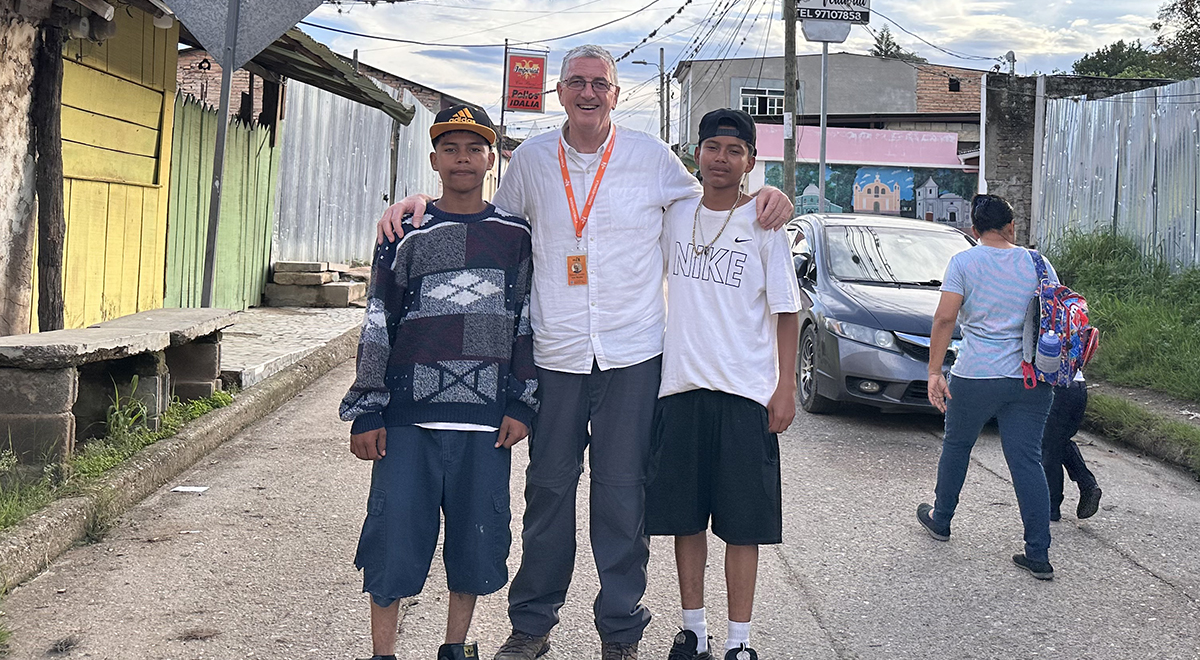
As I stand watching, two arms suddenly wrap tightly around my chest. A little game of hide and seek follows until a grin peeks around my shoulder. It’s Danny, 15 years old, a boy I remembered from my last trip. Right behind him is his twin brother, Angel.
The twins’ story is heartbreaking. Both boys have been out of the school system for years. Despite being “promoted” through three grades, they cannot read or write a single word.
How is that possible?
It’s not just their story; it’s Honduras’ story. The World Bank reports that nearly 8 in 10 children of late primary age in Honduras lack proficiency in reading skills. Imagine sitting through years of lessons and still being unable to understand a sentence. This occurs every day. Although 95% of children enrol in primary school, the reality is grim: only 6 out of every 20 will graduate from secondary school. By adolescence, almost 41% of boys aged 12–16 are already out of school.
The numbers are shocking. But sitting across from Danny and Angel, the statistics have faces.
Over lunch — their first meal of the day — they share fragments of their story. They live with their grandparents. Their grandmother is an alcoholic. Their grandfather struggles to provide, scraping together a living by copying and selling pirate films. Their mother is in Guatemala, and their father is absent. Hunger is a constant companion, and gangs hover at the edges of their young lives.
I look at them and silently count the risk factors: poverty, broken family ties, hunger, lack of education, and community violence. If not for Proyecto Alas, where would these boys be now?
Later that afternoon, I pulled out a piece of paper and asked the twins to write their names. Danny grips the pencil, carefully copying each letter of his name, struggling to tell “b” from “d.” Angel starts bravely, falters, and gives up. I gently guide his hand, tracing the letters of his name together. Each stroke of the pencil boosts his confidence, straightens his back, and lights up his face.
The next day, they run into the centre and wrap me in another hug. When I hand Angel the pencil again, he writes his name perfectly and without hesitation. His pride is uncontainable.
A small victory? Yes. But in Honduras, where dreams are slipping through the cracks of a broken education system, even one written name feels like a triumph.
Because when the school fails, the streets are waiting. They are waiting with false hopes, with gangs, drugs, exploitation, trafficking, and despair.
Yet here, in places like Micah Project and Proyecto Alas, hope still flickers. These centres are alive with small steps forward. Each hug, each hot meal, each carefully traced letter is defiance against despair.
At the end of the day, Angel looks at me with quiet determination. “One day,” he says softly, “I want to be like Sergio.” Sergio, once a street boy in Guatemala, is now a staff member at Alas. A young man who turned his story around and now mentors others to do the same.
For Angel and Danny, every letter matters, every day in the mentoring centre matters. For Honduras, every child who learns to read is a step away from the streets and a step toward hope.
The question is not whether change is possible, but whether we will choose to walk with them.
 Duncan Dyason is the founder and Director of Street Kids Direct and founder of TOYBOX UK, El Castillo in Guatemala and SKDGuatemala. He first started working with street children in 1992, when he moved to Guatemala City after watching the harrowing BBC documentary "They Shoot Children Don´t They?" His work has been honoured by Her Majesty the Queen, and he was awarded an MBE the year he celebrated working over 25 years to reduce the large population of children on the streets from 5,000 to zero. Duncan continues to live and volunteer with the Street Kids Direct charity in Guatemala City.